- First Impressions of Bhutan
 We arrived in Bhutan Monday afternoon the 21st. We touched down in the
western town of Paro just an hour after an earthquake struck in
eastern Bhutan, but didn’t hear any news about it until Wednesday.
Apparently this was the most powerful earthquake in Bhutan since 1941.
Over 1100 homes were destroyed and the death toll stands now at 13.
Cynthia and I are fine.
Tuesday was a holiday, the Rainy Day Festival, to celebrate the end of
the monsoon season. Actually, the day was sunny and pleasant. It was a
day for families to pack a picnic lunch and go out to watch archery
and darts competition.
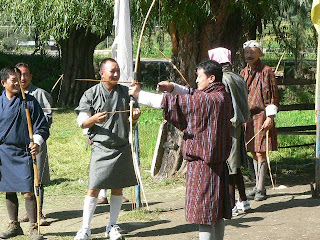
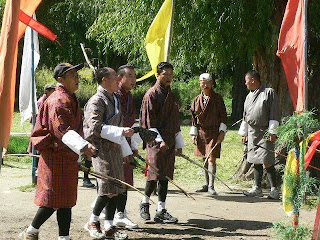
Archery is the national sport of Bhutan. Men use traditional wooden
bows and bamboo arrows. The target is placed 113 meters away and teams
vie for the greatest number of hits. Whenever anyone hits the target
(perhaps one out of twenty shots), the whole team stops to perform a
little dance together in celebration.
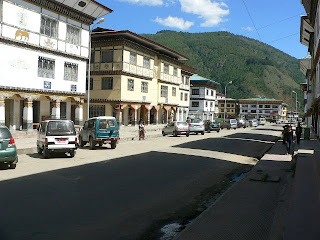
We spent two nights in Paro, then drove about 50 km to the capital
city of Thimphu. Both towns are a welcome contrast to Kathmandu —
nothing like the extremely crowded streets, the noise and the litter
that dominates the Kathmandu scene. Here, you are struck by how neat
and clean the streets are, the well kept homes and businesses and the
prevailing quiet, even in downtown Thimphu. Kathmandu suffers
immensely from the overcrowding, the unregulated over abundance of
cars, trucks, motorcycles and vans, and the deterioration of the city
due to the inability of the government to deal with any of the
pressing social issues.
In Bhutan, it’s clear that the leadership of a benevolent king has
been crucial for maintaining a way of life, preserving Bhutanese
culture, protecting the environment and cultivating a sustainable
economy.
The monarchy in Bhutan began in 1907 and there have been five kings
since then. The fourth king, now about 55 years old has turned over
power to his son, now 28. Last year the son relinquished his royal
authority to a democratically elected government. The Bhutanese people
were quite happy with the monarchy, but the fourth and fifth kings
have made it their mission to educate their people about the benefits
of a democratic system and have moved to install such a system to
replace the monarchy.
Prior to relinquishing power, the king set up an electoral commission,
an autonomous commission with the power to investigate corruption, two
legislative houses, and a supreme court. A constitution was drafted.
Now the country is gradually learning how to use these new democratic
institutions, while the king serves an advisory role only.
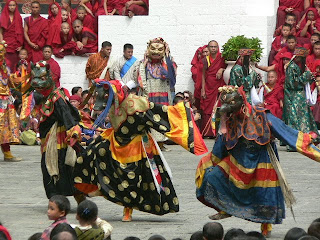
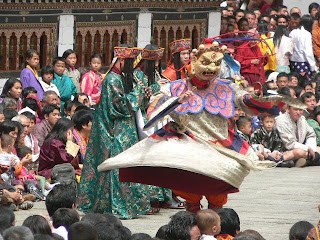
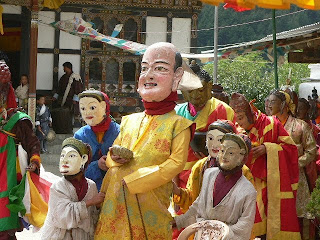
Today was a special festival in which people dressed in the finest
clothes and brought their families to the courtyard of the dzong where
they watched monks perform a dance with elaborate costumes and masks.
There were several thousand Bhutanese in attendance and a few dozen
foreign tourists.
We arrived in Bhutan Monday afternoon the 21st. We touched down in the
western town of Paro just an hour after an earthquake struck in
eastern Bhutan, but didn’t hear any news about it until Wednesday.
Apparently this was the most powerful earthquake in Bhutan since 1941.
Over 1100 homes were destroyed and the death toll stands now at 13.
Cynthia and I are fine.
Tuesday was a holiday, the Rainy Day Festival, to celebrate the end of
the monsoon season. Actually, the day was sunny and pleasant. It was a
day for families to pack a picnic lunch and go out to watch archery
and darts competition.
Archery is the national sport of Bhutan. Men use traditional wooden
bows and bamboo arrows. The target is placed 113 meters away and teams
vie for the greatest number of hits. Whenever anyone hits the target
(perhaps one out of twenty shots), the whole team stops to perform a
little dance together in celebration.
We spent two nights in Paro, then drove about 50 km to the capital
city of Thimphu. Both towns are a welcome contrast to Kathmandu —
nothing like the extremely crowded streets, the noise and the litter
that dominates the Kathmandu scene. Here, you are struck by how neat
and clean the streets are, the well kept homes and businesses and the
prevailing quiet, even in downtown Thimphu. Kathmandu suffers
immensely from the overcrowding, the unregulated over abundance of
cars, trucks, motorcycles and vans, and the deterioration of the city
due to the inability of the government to deal with any of the
pressing social issues.
In Bhutan, it’s clear that the leadership of a benevolent king has
been crucial for maintaining a way of life, preserving Bhutanese
culture, protecting the environment and cultivating a sustainable
economy.
The monarchy in Bhutan began in 1907 and there have been five kings
since then. The fourth king, now about 55 years old has turned over
power to his son, now 28. Last year the son relinquished his royal
authority to a democratically elected government. The Bhutanese people
were quite happy with the monarchy, but the fourth and fifth kings
have made it their mission to educate their people about the benefits
of a democratic system and have moved to install such a system to
replace the monarchy.
Prior to relinquishing power, the king set up an electoral commission,
an autonomous commission with the power to investigate corruption, two
legislative houses, and a supreme court. A constitution was drafted.
Now the country is gradually learning how to use these new democratic
institutions, while the king serves an advisory role only.
Today was a special festival in which people dressed in the finest
clothes and brought their families to the courtyard of the dzong where
they watched monks perform a dance with elaborate costumes and masks.
There were several thousand Bhutanese in attendance and a few dozen
foreign tourists. - Bhutan’s beauty
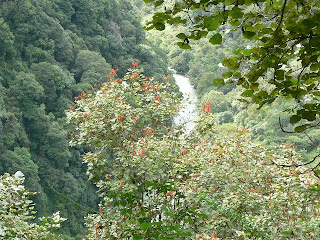
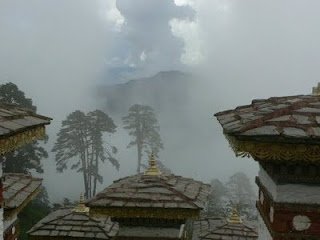
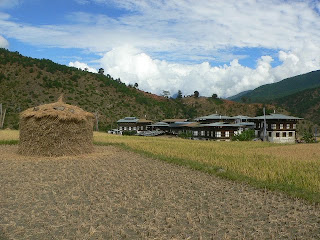
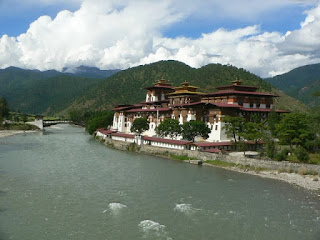 Our guide, Sangay, recommended by a friend on Whidbey Island, is wonderful, happily answering our endless questions. When we stayed on in Thimphu, his hometown, we were able to meet and have dinner with his family which gave us another look at Bhutanese life. We had a conversation with his wife about education here since she is a primary school teacher. The official policy is education for all children, but some children in rural areas still don’t receive an education.Although we attended the festival for the first day of the sacred cham (dance), there was such a big crowd of thousands that I, being of short stature, could see almost nothing. Fortunately, there was a second day of cham and because it was not an official holiday and most people were back to work and school, we were able to see everything clearly. The monks perform these sacred dances in elaborate costumes and masks after having performed rituals for 23 hours a day for the previous 15 days. The dances last several hours and are quite complex.These past two days we have traveled a hundred miles in about 7 hours of driving (2 hours yesterday, five today). We are traveling on the main east -west highway which is a very narrow, very winding, often one track road through some of the most beautiful scenery I have seen. Since Bhutan is entirely mountainous, we are always going up to passes or down into beautiful valleys, traveling through small villages.There is a plan afoot to increase tourism from 30,000 last year to 230,000 in five years. We and our guide think this is unrealistic and potentially harmful for the environment and the people of this country. This makes me very glad we are here now.
 - Bhutan slideshowFor a collection of photos of Bhutan, go to: http://www.flickr.com/photos/11790404@N02/sets/72157622449743440/show/
- David’s Bhutan observations
 We’re on a rather routine schedule here in Bhutan. Having a
prearranged tour means that we never have to figure out where to stay
or where to eat or how to get from one place to another. There’s one
main east-west road that winds around these mountains. It’s paved most
of the way but very narrow. Our driver skillfully negotiates the
curves, the occasional oncoming traffic and the passing around diesel
fume-spewing trucks.
Just as in Tibet, the cars here are equipped with seatbelts but no one
uses them. Generally at home I always use a seatbelt, so I feel
uncomfortable without one, especially as I look over the edge of these
steep mountain roads and witness vehicles passing with only a few
inches of clearance. Unfortunately, the back seat of our car is
covered with a Tibetan carpet that makes it impossible to insert the
buckle into the metal fitting. So for the past several weeks, I’ve
just been trying to accept the local custom of not using seatbelts,
and gradually I’ve forgotten about it.
However today, I started thinking about seatbelts again, especially
about how stupid we would seem to our children if we were to meet our
demise because we hadn’t buckled up. After lunch, I mentioned my
concern to our guide and we talked a bit about the seatbelt campaign
in the states, how we teach our children to use them and the safety
statistics. When we got back in the car, the Tibetan carpet was
removed and voila! Cynthia and I were able to fasten our belts. And so
did our guide (but not our driver). We only have a couple of days more
in the car, but maybe this will benefit some other guests in the
future. Cynthia asked if I felt better now … Yes, indeed I did, but
it’s nothing compared to how good I will feel as we roll over the
shoulder into a ravine.
The restaurants we visit have essentially the same fare, all served
buffet style — red rice, white rice, chow mein noodles, sliced beef,
roast potatoes, mixed vegetables, and the Bhutanese favorite,
chili-and-cheese. It’s amazing how similar the whole meal serving
routine is from one hotel to another. Seems that restaurateurs would
rather do what others have found to work with tourists rather than try
something new.
The hotels we’ve been staying in have hot showers, if you can figure
out how to regulate the temperature. Unlike some hotels in Nepal, the
shower drain seems to be installed at the lowest point of the tile
floor rather than somewhere else. Unpredictable as to which knob
controls the hot and which the cold, and sometimes puzzling as to how
to open and close the sink drain, but all still workable.
Every sizable town in Bhutan seems to have its own dzong — a large
fortress-like structure built in the mid 1600s and containing watch
towers, administrative offices, monks quarters and shrines. They each
accommodate both secular and religious functions and they are very
formidable. Some have burned at times over the past 400 years, but
they are always rebuilt and put into service again promptly. The first
four or five dzongs were quite fascinating, but they were all built in
the mid 1600s with similar architecture and by the 15th dzong, we felt
totally dzonged out.
Religion has an important role in Bhutanese daily life. It’s important
to make offerings to the various deities, both on designated days and
in accordance with things happening in one’s family and among one’s
friends. Buddhist shrines in Bhutan are quite interesting. Here is a
pop quiz question for you.
Question: Which of the following items would you NOT expect to find at
a Bhutanese Buddhist shrine?
(a) a statue of the Buddha or Guru Rinpoche
(b) a pile of money
(c) a multi-colored flower arrangement made out of butter
(d) an oversize anatomically correct model of an erect male organ
(e) an AK-47 rifle
See answer at the end of this post.
To an outsider, there are uncountable numbers of different deities and
historical figures the Bhutanese people pay homage to. However, there
is enough commonality among their attributes and icons that if a
person lived in this culture long enough, it would definitely be
something you would gradually develop a sense of. Guru Rinpoche is
one of the most prominent figures. There are his eight manifestations,
his consorts and his disciples. There are long lines of
reincarnations— of body, of speech and of mind. There are those lamas
who left secret treasures behind for others to find later (such as
sacred texts) and there are those treasure finders who found them.
There are all kinds of demons and evil spirits, and all kinds of
deities who subdued the demons and spirits. It would take a lifetime
of study to grasp all the personages, to say nothing of the daily
ritual practices and sacred objects.
Of course, all the items (a) – (e) can be found at the alter of
Bhutanese temples we have visited.
We’re on a rather routine schedule here in Bhutan. Having a
prearranged tour means that we never have to figure out where to stay
or where to eat or how to get from one place to another. There’s one
main east-west road that winds around these mountains. It’s paved most
of the way but very narrow. Our driver skillfully negotiates the
curves, the occasional oncoming traffic and the passing around diesel
fume-spewing trucks.
Just as in Tibet, the cars here are equipped with seatbelts but no one
uses them. Generally at home I always use a seatbelt, so I feel
uncomfortable without one, especially as I look over the edge of these
steep mountain roads and witness vehicles passing with only a few
inches of clearance. Unfortunately, the back seat of our car is
covered with a Tibetan carpet that makes it impossible to insert the
buckle into the metal fitting. So for the past several weeks, I’ve
just been trying to accept the local custom of not using seatbelts,
and gradually I’ve forgotten about it.
However today, I started thinking about seatbelts again, especially
about how stupid we would seem to our children if we were to meet our
demise because we hadn’t buckled up. After lunch, I mentioned my
concern to our guide and we talked a bit about the seatbelt campaign
in the states, how we teach our children to use them and the safety
statistics. When we got back in the car, the Tibetan carpet was
removed and voila! Cynthia and I were able to fasten our belts. And so
did our guide (but not our driver). We only have a couple of days more
in the car, but maybe this will benefit some other guests in the
future. Cynthia asked if I felt better now … Yes, indeed I did, but
it’s nothing compared to how good I will feel as we roll over the
shoulder into a ravine.
The restaurants we visit have essentially the same fare, all served
buffet style — red rice, white rice, chow mein noodles, sliced beef,
roast potatoes, mixed vegetables, and the Bhutanese favorite,
chili-and-cheese. It’s amazing how similar the whole meal serving
routine is from one hotel to another. Seems that restaurateurs would
rather do what others have found to work with tourists rather than try
something new.
The hotels we’ve been staying in have hot showers, if you can figure
out how to regulate the temperature. Unlike some hotels in Nepal, the
shower drain seems to be installed at the lowest point of the tile
floor rather than somewhere else. Unpredictable as to which knob
controls the hot and which the cold, and sometimes puzzling as to how
to open and close the sink drain, but all still workable.
Every sizable town in Bhutan seems to have its own dzong — a large
fortress-like structure built in the mid 1600s and containing watch
towers, administrative offices, monks quarters and shrines. They each
accommodate both secular and religious functions and they are very
formidable. Some have burned at times over the past 400 years, but
they are always rebuilt and put into service again promptly. The first
four or five dzongs were quite fascinating, but they were all built in
the mid 1600s with similar architecture and by the 15th dzong, we felt
totally dzonged out.
Religion has an important role in Bhutanese daily life. It’s important
to make offerings to the various deities, both on designated days and
in accordance with things happening in one’s family and among one’s
friends. Buddhist shrines in Bhutan are quite interesting. Here is a
pop quiz question for you.
Question: Which of the following items would you NOT expect to find at
a Bhutanese Buddhist shrine?
(a) a statue of the Buddha or Guru Rinpoche
(b) a pile of money
(c) a multi-colored flower arrangement made out of butter
(d) an oversize anatomically correct model of an erect male organ
(e) an AK-47 rifle
See answer at the end of this post.
To an outsider, there are uncountable numbers of different deities and
historical figures the Bhutanese people pay homage to. However, there
is enough commonality among their attributes and icons that if a
person lived in this culture long enough, it would definitely be
something you would gradually develop a sense of. Guru Rinpoche is
one of the most prominent figures. There are his eight manifestations,
his consorts and his disciples. There are long lines of
reincarnations— of body, of speech and of mind. There are those lamas
who left secret treasures behind for others to find later (such as
sacred texts) and there are those treasure finders who found them.
There are all kinds of demons and evil spirits, and all kinds of
deities who subdued the demons and spirits. It would take a lifetime
of study to grasp all the personages, to say nothing of the daily
ritual practices and sacred objects.
Of course, all the items (a) – (e) can be found at the alter of
Bhutanese temples we have visited. - Cynthia’s Bhutan observations
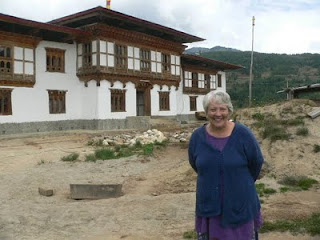
 After three days of travel we ended up in a tiny village outside the
small town of Jakar. As we drove through Jakar, it reminded me of a
wild west town with small wooden storefronts on both sides of a narrow
main street. Half of them were a General Store and Bar/Saloon.
Virtually all of them advertised cell phone recharging cards.
Across the road from our rural hotel was a small 14th century
monastery. We spent most of two days at the festival there which had a
very local flavor. The night before the festival the Lama came to
bless each house (and our hotel) in the neighborhood after which a
half naked monk dances through with a flaming branch.
That completed, we walked down the road to a field in which a large
circle of branches had been erected. The Lama’s completion of home
blessings and arrival at the circle signalled the masked scantily clad
monks to light the circle. The crowd of hundreds surged forward and
began moving through the circle, a purification ritual.
Next day the sacred ceremonies began at the monastery with rather
bawdy clowns (monks) entertaining the crowds with wooden phalluses
prior to the real cham (sacred dances) beginning. In the intimate
atmosphere of this small monastery, we were able to see the costumes,
masks and dances, musicians and locals’ reactions. These dances are
often lengthy and intricate which gave us a great appreciation for the
effort put into these ritual performances.
We were amazed at the number and size of cameras at this event. I
finally learned that a number of photography clubs from around the
world had organized excursions. I wish they had paid more attention to
honoring the local people and it’s significance to them. They came
across as fairly self-centered groups.
As interesting and colorful as it was, after 2 full days we were ready
to move on and begin our trek. The first day was a pleasant walk
through forest and fields, gaining a little altitude. Camp was set up
in a field above a river which was inhabited by cows, horses and dogs.
Nearby farmers were happy to porter tents, food and other supplies 3
km from across the river where the car was.
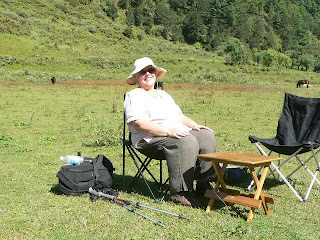
This was camping like I had never experienced it before. There were
folding chairs and a table and even a latrine tent and someone to cook
our food. Wow!
Because of the ongoing challenge of my knees, David thought having a
horse in reserve was a good idea. Since there were horses already
going over the pass carrying supplies for another group, this was no
problem. My success the first day made me quite determined to cross
the pass on my own two feet. Allieve at night and -Ibuprofon in the
morning seemed a winning combination plus the aid of my hiking poles.
The temperature was perfect, my shoes were comfortable and I was
confident as we started climbing through beautiful forest of
evergreens, rhododendrons, bamboo, and a diversity of plants we had
never seen before. We wondered if David Hinkley had cataloged or
propagated the plants of Bhutan.
We continued to play leap frog with the farmers and group of horses
and each time I was asked if I wanted a horse yet. Given that the
saddles were uncomfortable wooden things and the path frequently very
steep over large rocks and occasionally less than a foot wide with a
precipice on one side, I felt far safer on my own 2 feet. It was a
long way up and I was exhausted and very sore by the time we got to
the pass. The prayer flags flying all around us immediately lifted my
spirits as we shared lunch with Sangay, our very steady guide. He said
it would be about an hour down to here our camp would be. Three hours
later with dusk upon us, I dragged into camp, wanting only to wash up
and sleep. After forcing down a bowl of soup, I did bask in my
accomplishment. I did it on my own 2 feet and my walking sticks and
with the support and encouragement of David and Sangay, both very
patient men.
It was a brief 2 hour hike the next day to a small very rustic house
(actually the vacation home of the minister of agriculture) where we
spent the next two nights. We also became acquainted with a Bhutanese
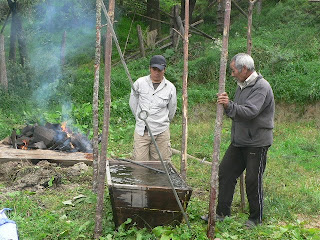
tradition, the hot stone bath.
Large stones are heated on top of a fire until they are white hot,
then they are put in a wooden tub of fresh spring water. This steaming
hot outdoor bath is very soothing after physical exertion. We are
thinking of building one at Greenbank.
The next couple of days we had shorter hikes to nearby dzongs and
visited a nunnery which is under construction. As in China, I felt a
completely different energy at the nunnery than I felt at the
monasteries. We saw the small cell that 4 nuns shared and had tea with
them. Some part of me would have liked the opportunity to spend a few
days with them. The other still aching part of me realized that I
would be useless in the hard work of construction that they were
engaged in. Maybe on another visit.
We are back in Thimpu, the only capital city in the world without so
much as a single traffic light. In a few days we will be leaving
Bhutan, but not without dreams of someday returning.
After three days of travel we ended up in a tiny village outside the
small town of Jakar. As we drove through Jakar, it reminded me of a
wild west town with small wooden storefronts on both sides of a narrow
main street. Half of them were a General Store and Bar/Saloon.
Virtually all of them advertised cell phone recharging cards.
Across the road from our rural hotel was a small 14th century
monastery. We spent most of two days at the festival there which had a
very local flavor. The night before the festival the Lama came to
bless each house (and our hotel) in the neighborhood after which a
half naked monk dances through with a flaming branch.
That completed, we walked down the road to a field in which a large
circle of branches had been erected. The Lama’s completion of home
blessings and arrival at the circle signalled the masked scantily clad
monks to light the circle. The crowd of hundreds surged forward and
began moving through the circle, a purification ritual.
Next day the sacred ceremonies began at the monastery with rather
bawdy clowns (monks) entertaining the crowds with wooden phalluses
prior to the real cham (sacred dances) beginning. In the intimate
atmosphere of this small monastery, we were able to see the costumes,
masks and dances, musicians and locals’ reactions. These dances are
often lengthy and intricate which gave us a great appreciation for the
effort put into these ritual performances.
We were amazed at the number and size of cameras at this event. I
finally learned that a number of photography clubs from around the
world had organized excursions. I wish they had paid more attention to
honoring the local people and it’s significance to them. They came
across as fairly self-centered groups.
As interesting and colorful as it was, after 2 full days we were ready
to move on and begin our trek. The first day was a pleasant walk
through forest and fields, gaining a little altitude. Camp was set up
in a field above a river which was inhabited by cows, horses and dogs.
Nearby farmers were happy to porter tents, food and other supplies 3
km from across the river where the car was.
This was camping like I had never experienced it before. There were
folding chairs and a table and even a latrine tent and someone to cook
our food. Wow!
Because of the ongoing challenge of my knees, David thought having a
horse in reserve was a good idea. Since there were horses already
going over the pass carrying supplies for another group, this was no
problem. My success the first day made me quite determined to cross
the pass on my own two feet. Allieve at night and -Ibuprofon in the
morning seemed a winning combination plus the aid of my hiking poles.
The temperature was perfect, my shoes were comfortable and I was
confident as we started climbing through beautiful forest of
evergreens, rhododendrons, bamboo, and a diversity of plants we had
never seen before. We wondered if David Hinkley had cataloged or
propagated the plants of Bhutan.
We continued to play leap frog with the farmers and group of horses
and each time I was asked if I wanted a horse yet. Given that the
saddles were uncomfortable wooden things and the path frequently very
steep over large rocks and occasionally less than a foot wide with a
precipice on one side, I felt far safer on my own 2 feet. It was a
long way up and I was exhausted and very sore by the time we got to
the pass. The prayer flags flying all around us immediately lifted my
spirits as we shared lunch with Sangay, our very steady guide. He said
it would be about an hour down to here our camp would be. Three hours
later with dusk upon us, I dragged into camp, wanting only to wash up
and sleep. After forcing down a bowl of soup, I did bask in my
accomplishment. I did it on my own 2 feet and my walking sticks and
with the support and encouragement of David and Sangay, both very
patient men.
It was a brief 2 hour hike the next day to a small very rustic house
(actually the vacation home of the minister of agriculture) where we
spent the next two nights. We also became acquainted with a Bhutanese
tradition, the hot stone bath.
Large stones are heated on top of a fire until they are white hot,
then they are put in a wooden tub of fresh spring water. This steaming
hot outdoor bath is very soothing after physical exertion. We are
thinking of building one at Greenbank.
The next couple of days we had shorter hikes to nearby dzongs and
visited a nunnery which is under construction. As in China, I felt a
completely different energy at the nunnery than I felt at the
monasteries. We saw the small cell that 4 nuns shared and had tea with
them. Some part of me would have liked the opportunity to spend a few
days with them. The other still aching part of me realized that I
would be useless in the hard work of construction that they were
engaged in. Maybe on another visit.
We are back in Thimpu, the only capital city in the world without so
much as a single traffic light. In a few days we will be leaving
Bhutan, but not without dreams of someday returning. - Farewell Thoughts of Bhutan
 [Written by Cynthia Oct 8th, 2009]
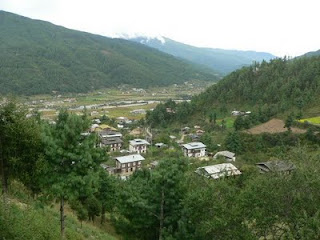
In some ways Bhutan seems like a much larger country than it actually
is. In this small country there are 14 dialects and 16 different
ethnic groups. It seems surprising that it developed a national
identity centuries ago. It is likely that the strong spiritual
practice of Buddhism is a major factor.
Although it is less than 400 miles across the main transportation
route, the east-west highway, it takes two full ten hour days to drive
that distance. This drive is not for one subject to car sickness. The
road has few sections that are straight for as much as 20 feet as if
winds up and down through the mountains which cover most of the
country.
We found ourselves grateful to have arrived back in Thimphu just ahead
of the recent unseasonable 30 hours of continuous hard rain. It is
likely some of the road we just traveled has been blocked by
landslides. Yesterday in traveling 2 hours to Paro, there were many
large rocks and a few huge boulders on the road making travel
hazardous.
The only airport in Bhutan here in Paro was completely shut down
yesterday and we are uncertain what it will take to catch up as only
one airline with two planes flies into this airport. We are scheduled
to fly to Kathmandu tomorrow and will wait and see if flights are back
on schedule. As I write, the sky is clearing and I just saw a plane
take off.
We feel concern for trekkers in the mountains when this storm
occurred. Hiking here involves crossing many streams and rivers, often
by balancing on logs or jumping from rock to rock. Many of these
temporary “bridges” many have washed away and some of the more
permanent ones may be damaged. I am certain that the people living in
the mountains will find ways to get trekkers safely down but it may
take some time.
As I look out my window there are already white sheets, towels and
pillowcases drying on the line and things are getting back to normal.
[Written by Cynthia Oct 8th, 2009]
In some ways Bhutan seems like a much larger country than it actually
is. In this small country there are 14 dialects and 16 different
ethnic groups. It seems surprising that it developed a national
identity centuries ago. It is likely that the strong spiritual
practice of Buddhism is a major factor.
Although it is less than 400 miles across the main transportation
route, the east-west highway, it takes two full ten hour days to drive
that distance. This drive is not for one subject to car sickness. The
road has few sections that are straight for as much as 20 feet as if
winds up and down through the mountains which cover most of the
country.
We found ourselves grateful to have arrived back in Thimphu just ahead
of the recent unseasonable 30 hours of continuous hard rain. It is
likely some of the road we just traveled has been blocked by
landslides. Yesterday in traveling 2 hours to Paro, there were many
large rocks and a few huge boulders on the road making travel
hazardous.
The only airport in Bhutan here in Paro was completely shut down
yesterday and we are uncertain what it will take to catch up as only
one airline with two planes flies into this airport. We are scheduled
to fly to Kathmandu tomorrow and will wait and see if flights are back
on schedule. As I write, the sky is clearing and I just saw a plane
take off.
We feel concern for trekkers in the mountains when this storm
occurred. Hiking here involves crossing many streams and rivers, often
by balancing on logs or jumping from rock to rock. Many of these
temporary “bridges” many have washed away and some of the more
permanent ones may be damaged. I am certain that the people living in
the mountains will find ways to get trekkers safely down but it may
take some time.
As I look out my window there are already white sheets, towels and
pillowcases drying on the line and things are getting back to normal. - Visit to Taktsang Hermitage

 [Written by David Oct 8, 2009]
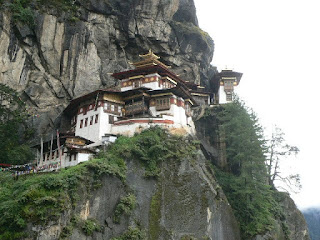
The Taktsang (Tiber’s Lair) hermitage is located on the face of a
sheer 3,000 ft cliff above the Paro valley. The trail up to the
hermitage is steep and requires a lot of knee action, so Cynthia
decided wisely to sit this one out. Sangay and I set out in a light
rain and thick clouds; we had no idea what we would be able to see
when we got there. But as we moved up, the clouds lifted and the rain
stopped and the hermitage came into view in all its glory.
The several temples have been recently rebuilt as they were destroyed
by fire in 1998. The new temples have been authentically restored and
are quite impressive.
The head lama, Lama Dorje is a freind of Sangay, so he invited us in
for tea. Apparently he is a highly revered and well known lama who has
many disciples. I used the opportunity to ask him what was the most
important teaching of Buddhism to be remembered.
He replied simply, “learning to control the mind”.
At dinner yesterday evening, Cynthia and I were talking with Sangay
about the phallus symbols that we saw in some temples. Today, Sangay
asked the lama what the meaning was of these. He said that there was
no meaning in Buddhism. He though that perhaps they were put there by
lay monks who did not fully understand.
According to Sangay, the mages of phalluses painted on the walls of
people’s homes and the wooden phalluses suspended from the roof
corners were believed to protect the home from evil spirits. He didn’t
think they were fertility symbols..
Obviously the phallus had prominent role among the clowns or jesters
during the sacred dances we saw in Jakar. They made quite a display of
miming sexual activity, often directly with members of the audience,
especially the tourists. There is certainly a great deal of overlap
between the role of the phallus in Bhutanese culture and its role in
Buddhiist temples.
I also asked the lama about the meaning of the AK-47 rifle that we saw
in two temples we visited. He said that the protector dieties have
always had weapons — originally swords and bows and arrows, and that
the AK-47 was just another weapon for protection.. He said that
ideally, the protective dieties would have all the weapons of the
world, but since they couldn’t all be included, these would have to
suffice.
We heard a story about how long ago a lama created a miraculous animal
from the bones of a goat and an ox. The animal, called the Takin is
the national animal of Bhutan. It does in fact resemble a goat, but
it’s much larger. The information at the Takin refuge says that it has
been difficult for taxonomists to classify the animal, given its
unique characteristics.
[Written by David Oct 8, 2009]
The Taktsang (Tiber’s Lair) hermitage is located on the face of a
sheer 3,000 ft cliff above the Paro valley. The trail up to the
hermitage is steep and requires a lot of knee action, so Cynthia
decided wisely to sit this one out. Sangay and I set out in a light
rain and thick clouds; we had no idea what we would be able to see
when we got there. But as we moved up, the clouds lifted and the rain
stopped and the hermitage came into view in all its glory.
The several temples have been recently rebuilt as they were destroyed
by fire in 1998. The new temples have been authentically restored and
are quite impressive.
The head lama, Lama Dorje is a freind of Sangay, so he invited us in
for tea. Apparently he is a highly revered and well known lama who has
many disciples. I used the opportunity to ask him what was the most
important teaching of Buddhism to be remembered.
He replied simply, “learning to control the mind”.
At dinner yesterday evening, Cynthia and I were talking with Sangay
about the phallus symbols that we saw in some temples. Today, Sangay
asked the lama what the meaning was of these. He said that there was
no meaning in Buddhism. He though that perhaps they were put there by
lay monks who did not fully understand.
According to Sangay, the mages of phalluses painted on the walls of
people’s homes and the wooden phalluses suspended from the roof
corners were believed to protect the home from evil spirits. He didn’t
think they were fertility symbols..
Obviously the phallus had prominent role among the clowns or jesters
during the sacred dances we saw in Jakar. They made quite a display of
miming sexual activity, often directly with members of the audience,
especially the tourists. There is certainly a great deal of overlap
between the role of the phallus in Bhutanese culture and its role in
Buddhiist temples.
I also asked the lama about the meaning of the AK-47 rifle that we saw
in two temples we visited. He said that the protector dieties have
always had weapons — originally swords and bows and arrows, and that
the AK-47 was just another weapon for protection.. He said that
ideally, the protective dieties would have all the weapons of the
world, but since they couldn’t all be included, these would have to
suffice.
We heard a story about how long ago a lama created a miraculous animal
from the bones of a goat and an ox. The animal, called the Takin is
the national animal of Bhutan. It does in fact resemble a goat, but
it’s much larger. The information at the Takin refuge says that it has
been difficult for taxonomists to classify the animal, given its
unique characteristics. - Gross National Happiness
 Since the 1970s, the king of Bhutan has been advocating the concept of
“Gross National Happiness” (GNH) as measure of societal well-being. He
has often contrasted this idea with the widely used measure of
economic development, the “Gross Domestic Product” (GDP).
Computation of a country’s GNH uses a “methodology of multidimensional
poverty” developed by Alkire and Foster. It uses 72 indicators of
well-being, including both numerical and categorical variables.
Examples of numerical variables include number of years of schooling
or annual income. Examples of categorical variables would be answers
to questions such as, “In general, how would you describe the state of
your health? (Excellent, Good, or Poor)” And “To what extent do you
trust the media? (Trust, Trust Somewhat, or Distrust)”
Quoting below from an article in Business Bhutan, Sept 26, 2009, Vol 1, Issue 1:
__________
Last month, the Prime Minister [of Bhutan], Lyonchen Jigme Y. Thinley,
delivered a speech on Gross National Happiness (GNH) in Japan where he
said the world now has to review its pursuit of economic progress.
Three weeks later, on September 14, the same message echoed from
France but with a new found optimism. The French President, Nicolas
Sarcozy, declared that France “plans to include happiness and
well-being in its measurement of economic progress.”
The president made his assertion after embracing a study he
commissioned last year was published. The study was led by two Nobel
laureates, Joseph Stiglitz and Amartya Sen, with 23 other experts
including four other Nobel laureates who studied the limitation of
having Gross Domestic Product (GDP) as a measure of economic
development.
Summing up the study, Joseph Stiglitz said, “The main message is to
get away from GDP fetishism and to understand the limits to it.”
Addressing President Sarkozy’s new found reason for hope for the
future, Lyonchen Jigme Y. Thinley told Business Bhutan, “the world is
acknowledging Bhutan’s intellectual leadership” in “human society’s
search for an alternative development paradigm, an alternative
framework for the growth and continued progress of human society.”
…
GNH was advocated by the fourth [king of Bhutan] Druk Gyalpo igme
Singye Wangchuck since the 1970s who declared collective happiness as
the national goal.
…
Joseph Stiglitz describes GDP as a “false choice” for measuring
national progress. The GDP measures market economic activity and not
societal well-being. He added, “What we measure affects what we do. If
we have wrong metrics, we will strive for wrong things.”
Advocates of happiness as an index stress that an increase in GDP can
also occur in a society where the majority of the citizens have become
worse off. GDP does not take into account unemployment, cultural
disintegration, resource depletion or environmental degradation.
Tshoki Zangmo of the Center for Bhutan Studies said, “In GDP,
externalities, i.e. Outside events over which we have no control —
such as war, natural disasters and disease — and which lead to
increased spending would be considered to be unambiguously positive
inasmuch as they increase economic activity.”
…
The economic affairs minister, Lyonpo Khandu Wangchuk said pursuance
of GNH does not mean undermining economic growth.
He said that Bhutan is looking to contribute to GNH through economic
development. Only through sound economic development can a country
have peace, security and prosperity.
“For Bhutan, the transition to a successful democracy can only be
possible with economic development” he said “because only then can we
meet the aspirations of the people.”
While the French President publicly made a bidding of his new claim,
Bhutan was not mentioned even once. Neither the 291-page report nor
its five-page references used for the study, mentions Bhutan. But the
findings of the report bear stark similarities with the works of the
Center of Bhutan Studies which has been trying to quantify GNH for
about five years now.
__________
Makes some good sense to me!
Since the 1970s, the king of Bhutan has been advocating the concept of
“Gross National Happiness” (GNH) as measure of societal well-being. He
has often contrasted this idea with the widely used measure of
economic development, the “Gross Domestic Product” (GDP).
Computation of a country’s GNH uses a “methodology of multidimensional
poverty” developed by Alkire and Foster. It uses 72 indicators of
well-being, including both numerical and categorical variables.
Examples of numerical variables include number of years of schooling
or annual income. Examples of categorical variables would be answers
to questions such as, “In general, how would you describe the state of
your health? (Excellent, Good, or Poor)” And “To what extent do you
trust the media? (Trust, Trust Somewhat, or Distrust)”
Quoting below from an article in Business Bhutan, Sept 26, 2009, Vol 1, Issue 1:
__________
Last month, the Prime Minister [of Bhutan], Lyonchen Jigme Y. Thinley,
delivered a speech on Gross National Happiness (GNH) in Japan where he
said the world now has to review its pursuit of economic progress.
Three weeks later, on September 14, the same message echoed from
France but with a new found optimism. The French President, Nicolas
Sarcozy, declared that France “plans to include happiness and
well-being in its measurement of economic progress.”
The president made his assertion after embracing a study he
commissioned last year was published. The study was led by two Nobel
laureates, Joseph Stiglitz and Amartya Sen, with 23 other experts
including four other Nobel laureates who studied the limitation of
having Gross Domestic Product (GDP) as a measure of economic
development.
Summing up the study, Joseph Stiglitz said, “The main message is to
get away from GDP fetishism and to understand the limits to it.”
Addressing President Sarkozy’s new found reason for hope for the
future, Lyonchen Jigme Y. Thinley told Business Bhutan, “the world is
acknowledging Bhutan’s intellectual leadership” in “human society’s
search for an alternative development paradigm, an alternative
framework for the growth and continued progress of human society.”
…
GNH was advocated by the fourth [king of Bhutan] Druk Gyalpo igme
Singye Wangchuck since the 1970s who declared collective happiness as
the national goal.
…
Joseph Stiglitz describes GDP as a “false choice” for measuring
national progress. The GDP measures market economic activity and not
societal well-being. He added, “What we measure affects what we do. If
we have wrong metrics, we will strive for wrong things.”
Advocates of happiness as an index stress that an increase in GDP can
also occur in a society where the majority of the citizens have become
worse off. GDP does not take into account unemployment, cultural
disintegration, resource depletion or environmental degradation.
Tshoki Zangmo of the Center for Bhutan Studies said, “In GDP,
externalities, i.e. Outside events over which we have no control —
such as war, natural disasters and disease — and which lead to
increased spending would be considered to be unambiguously positive
inasmuch as they increase economic activity.”
…
The economic affairs minister, Lyonpo Khandu Wangchuk said pursuance
of GNH does not mean undermining economic growth.
He said that Bhutan is looking to contribute to GNH through economic
development. Only through sound economic development can a country
have peace, security and prosperity.
“For Bhutan, the transition to a successful democracy can only be
possible with economic development” he said “because only then can we
meet the aspirations of the people.”
While the French President publicly made a bidding of his new claim,
Bhutan was not mentioned even once. Neither the 291-page report nor
its five-page references used for the study, mentions Bhutan. But the
findings of the report bear stark similarities with the works of the
Center of Bhutan Studies which has been trying to quantify GNH for
about five years now.
__________
Makes some good sense to me! - more photos of BhutanI’ve uploaded more photos to our Bhutan slideshow, at http://www.flickr.com/photos/11790404@N02/sets/72157622449743440/show/ Enjoy! David


