New Zealand
New Zealand, 2014
Southern Sky Astronomy Tour
Kawerau
We enjoyed a Servas visit with our hosts Brenda and Jimmy Paul, a Maori couple who live in the small town of Kawerau with a diminishing population since the company downsized. Each of their five children have moved away in order to earn a living which changes the culture of the close-knit Maori community. She grew up in a rural Maori area and has been bilingual most of her life. Jimmy grew up in a coastal town and learned Maori from Brenda. Brenda served as the Maori teacher in preschools in the area. There is strong government support for keeping the Maori culture alive which appears to be well supported by the dominate white New Zealander society. In fact, some of English extraction would prefer the traditional Maori name, Aotearoa, “land of the long white cloud,” as the name of this country and even expect that it will change within a few years.
Both Jimmy and Brenda are hard working people who value all they have, exhibit great warmth and much interest and curiosity about the rest of the world. They have traveled to Japan to visit the families of the many Japanese students who have stayed with them and plan to visit Europe and the US. We appreciated that they could send us directions to destination sites, waterfalls and lakes well off the radar of most tourists.
We took them out to dinner. They chose a restaurant that was housed in the building where they met over 45 years ago.
New Zealand Falcon
The New Zealand Falcon is the only bird of prey endemic to New Zealand. It is a threatened species, with only about 3,000 breeding pairs surviving. Efforts are underway to rehabilitate injured birds and to train birds hatched in captivity to hunt on their own using falconry methods. We visited the Wingspan National Bird of Prey Centre and saw a demonstration of a New Zealand Falcon being trained in this way.
Paper Mill tour
Our Servas hosts Brenda and Jimmy Paul live in Kawerau, where Jimmy works in the paper mill. I asked him about him about visiting the plant and he graciously arranged a tour for us. The plant has been in operation since the 1960s, when it was locally owned. At its peak in the 1990s, it ran three paper machines 24/7 and employed 3,000 people. Now it is owned by a Norwegian company, employs a few hundred people and operates just one machine.
![]() |
| Requisite safety gear for the tour |
Pine trees are grown in large plantations for both paper making and logs. The top third of the tree, containing the softest wood is used for paper. The wood is chopped up into chips, then cooked in a huge pressure cooker, which turns it into pulp which is fed into the paper making machine.
![]() Equipment for cooking wood chips into pulp |
![]() |
| The paper mill processes a pile of logs like this in just one day. |
![]() |
| Wood chips being fed into the cooker |
![]() |
| Paper production begins at this end of the machine where a slurry of 99.5% water and 0.5% pulp is sprayed onto a nylon mesh screen. |
![]() |
| Water is extracted using a vacuum process, a continuous belt of felt and dozens of heated rollers. It takes only 9 seconds for the pulp to be converted to paper from one end of the mill to the other. |
![]() |
| Here the paper roll is cut into lengths of about 5 ft and shorter. |
![]() |
| A single roll of paper is 65 kilometers long! |
![]() |
| Finished rolls ready to be shipped |
![]() |
| Forklifts equipped with special suction heads are used to load paper rolls onto rail cars. |
This experience has given me a new perspective on the paper we use every day.
David
Gannets
From the moment we boarded our Whidbey-SeaTac shuttle, boarded a Virgin America flight to LAX and finally settled into our 12 hour Air New Zealand flight, comfort and service was front and center. Before we deplaned in Auckland, we had an invitation to stay in the apartment of one of our fellow passengers. Warmth and hospitality have been the theme for all our encounters with New Zealanders. In using various systems of transportation on our first day, we were given immediate assistance for trains, buses and ferries to acquaint ourselves with this city and were quite pleased to retrace our steps to Eden Park where we spent our first night.
The following morning, our first Servas hosts, Mary and Graham Sweet (sweetwanders), arrived and gave us a driving tour of this city and it’s surroundings, where half the population of the country lives. Mary and Graham have explored their homeland as well as many other areas of the world. They completely gave themselves over to guiding and visiting with us, taking us to view the cliff top nesting areas of thousands of gannets and terns. Hiking above them, we were able to look down, observing their behavior—nurturing their chicks and necking with their mates.
We were introduced to their friends who were similarly easy going and friendly. They were invaluable in advising us of places we might enjoy as we make our way to Rotorua. The past two days spent on the Coromandel Peninsula has been a treat with wonderful views, walks and the most winding roads I have ever had the delight to drive on. Fortunately I have remembered to stay on the left side of the road.
Cynthia
![]() |
![]() |
| A gannet landing on the rocks |
![]() |
| Gannet chick, hatched a few weeks ago |
![]() |
| Gannet rookery |
First Impressions of New Zealand
New Zealand is green, lush and varied. There is as much greenery as we see at our home on Whidbey Island, but with some fascinating variations. Some of the forest plants look familiar—pines, cypress, juniper, ocean spray, while others would be entirely out of place on Whidbey—palm trees and huge fern trees. There are Norfolk pines but no Douglas fir or red cedar. Like Whidbey, New Zealand is surrounded by water. Vistas often include ocean views out to the horizon, many with sandy beaches or rocky shores. Auckland is generally flat and surrounded by immense tidal mud flats. Shore birds congregate by the hundreds on the mud flats at low tide.
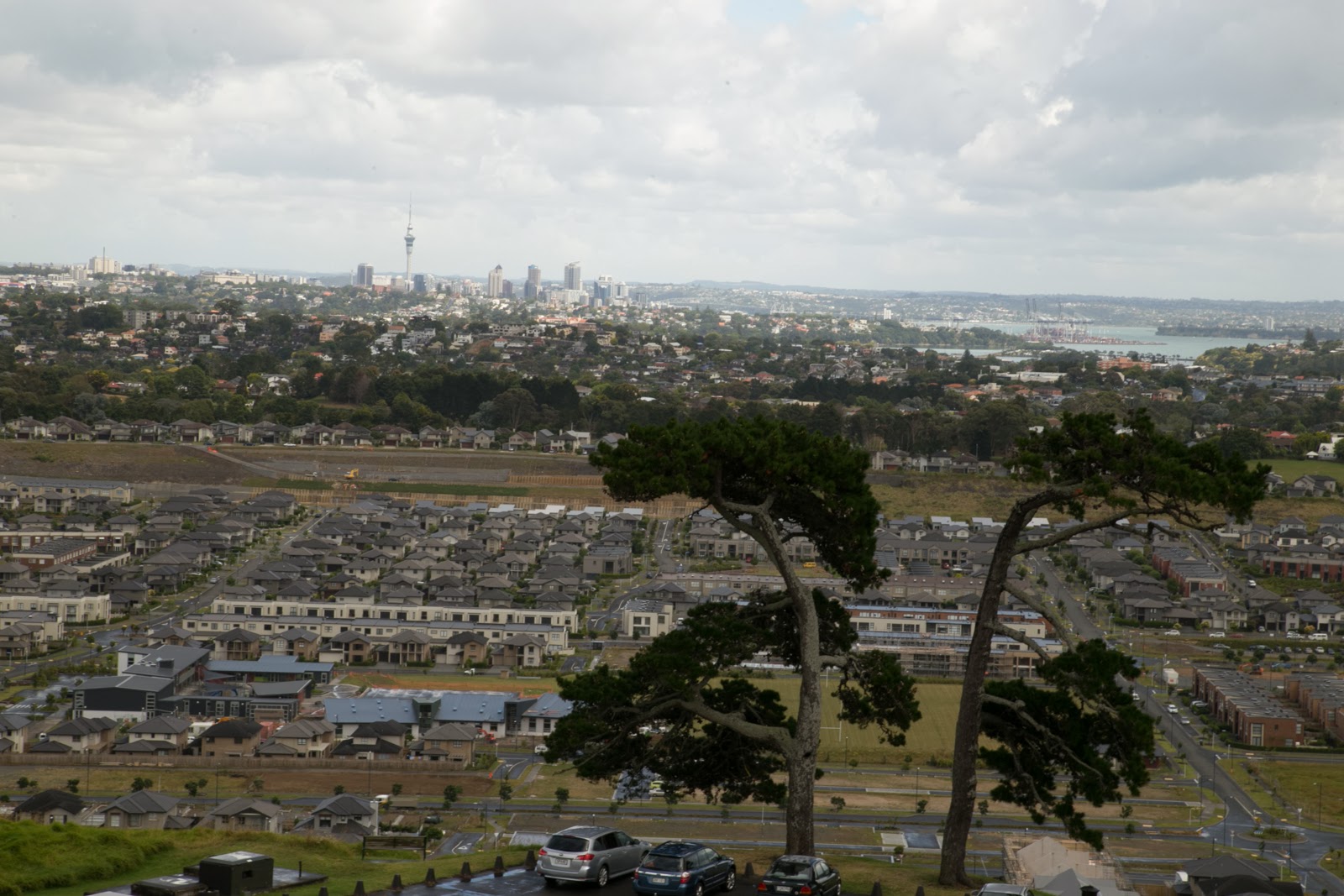
The low topography of Auckland is punctuated with small volcanoes. The volcanoes are typically millions of years old but some have erupted as recently as 600 years ago. They are indicated by their roughly conical shape with a crater sculpted out of the peak and are now covered with grass and low shrubs.
Auckland is a small big-city. It has all the amenities and services of a metropolis, but without the sky scrapers. We didn’t see many buildings taller than 4-5 stories. The freeways carry traffic without strain. Even at rush hour, cars were moving at a good clip. The divided highways don’t seem to extend far beyond Auckland. It’s easy to get out of the city and into the countryside.
Walking near our motel in the Eden Park neighborhood, we were struck by the variety of ethnic restaurants in a single block: Mekong Neua (Thai and Laos cuisine), Le garde-manger, Canton Cafe, Tanoshimi Cafe, Gyros Kebab and Bangkok (Eat In & Takeaways) and Little India. We chose the Roasted Addiqtion where I had a latte and lox with cream cheese on a bagel for breakfast.
We caught a taxi from the airport and chatted with our driver, a Sikh man from Punjab. He has been living, studying and working in New Zealand for seven years. He told us he will be returning to Punjab next month for a wedding. In fact, the wedding will be his own; he will be marrying a young Punjabi woman. Probing a bit further, we learned that, while the date has been set and many of his family members have been invited, at this moment, he actually doesn’t know who the bride will be. But he is confident that his parents will find someone suitable in time for the ceremony.
While it was a bit difficult for us to wrap our minds around that situation, we appreciated that in the culture of India, a marriage is as much an arrangement between two families as it is a relationship between two people. We were impressed by his confidence and wished him well.
David
![]() |
| View of Auckland from Mt Wellington |
![]() |
| Cynthia (center) with our Servas hosts, Graham and Mary |
![]() |
| The crater at the top of Mt Wellington volcano |
![]() |
| A young volcano (600 years) across the harbor |