Serendipity in Townsville

We have joined Servas International, a worldwide cultural exchange network in which members host international travelers in their homes for a few days at a time without accepting payment. The mission of the organization is to “build understanding, tolerance, mutual respect, and world peace” by “encouraging individual person-to-person contacts.” Our experience has been discovering things we had no idea we would encounter when we set out, but we are incredibly grateful for. We arrived in Sydney, Australia with essentially no itinerary at all. Many people aboard the ship to Antarctica asked us where we planned to go in Australia and what we planned to do. Sheepishly, we had to say we really didn’t know. We would just see what happened. Our Servas hosts were the key. We contacted a Servas family living near Townsville on coast in Queensland and stayed with them three nights. Leigh and Geoff built their home on fifty acres of bushland.

They have kangaroos, wallabies and bettongs coming up to the house every day looking for hand-outs. A wallaby looks like a small kangaroo. We watched a pair of male agile wallabies engaged in what looked like a boxing match. It seemed an important part of the ritual was stopping occasionally to take a good scratch.

A pademelon is another marsupial somewhat smaller than a wallaby.
A bettong is an even smaller kangaroo-like creature. There were several that came up to the house after sunset.

Leigh has a friend Margaret in Townsville who devotes herself to rescuing kangaroo, wallaby and echidna babies whose mothers have been killed, usually the result of being hit by cars on the highway. When babies are discovered in the pouches of their injured or killed mothers, Margarat adopts them, feeds them, nurtures them and trains them to survive in the wild on their own. We had a chance to visit Margaret and hold the babies. Remarkable!

On the evening of the second day of our stay, Leigh invited us to attend Happy Feat, a dance program that she designed for people with special needs. This too was a wonderful experience, one for which we had absolutely no expectations. We had a blast.

Travels in Eastern Australia

In early March, Julian joined us in Sydney, having spent several weeks in Japan. We met him at the airport prepared to fly to Tasmania. Shortly before our scheduled take off, we noticed huge black clouds heading straight for the airport.  A short time later thunder, monsoon rain and lightning filled the air. Over the loudspeaker it was announced that the airport was on shutdown.  No landings, no takeoffs.  Then we saw on the large flat screens around the airport that the big story on local TV stations was the superstorm that had shut down the airport. We boarded a rescheduled flight the next morning

Our hosts throughout Australia have contributed greatly to our experience. We had a week’s stay with Air B&B hosts Juanita and Richard just outside Hobart in Tasmania. They and Rosie (a native Tasmanian, living part time on Whidbey) were very helpful in making the most of our time. We had the lower level of the house, two large rooms and a small kitchen and a lovely garden. Located high on a hill above Blackmans Bay, we had spectacular sunrises and, from the top of the driveway equally lovely sunsets. It was a great place to set out each morning to visit the southern portion of this large island state. We had some lovely hikes and saw a few of Australia’s signature animals.

We made our way to Port Douglas so that Julian and David could get some time in at the Great Barrier Reef, while I spent time with a local aboriginal man learning much about the rain forest plants and their uses and hearing stories of the spirits that inhabit this area.

While in the area, we had a lovely stay with Catherine and Nigel, staff members of the Antarctica Expedition. It was quite a change for all of us to be dressed in clothing to suit the tropical climate of northeast Australia. No wellies or polar jackets in sight!  The spectacular home they have designed and built themselves really suits this location, a round two story stone house which totally opens to welcome the outdoors.

We enjoyed a swim in their nearby crocodile-free swimming hole after a day exploring the Daintree Rainforest.

Cynthia

Snorkeling the Great Barrier Reef

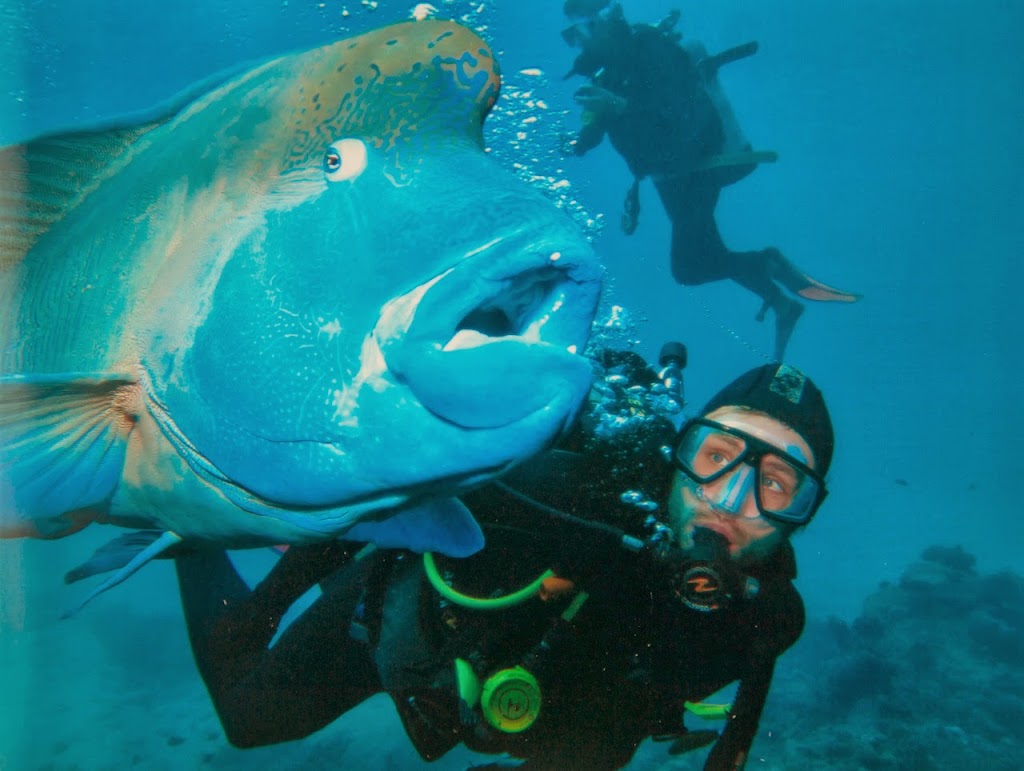
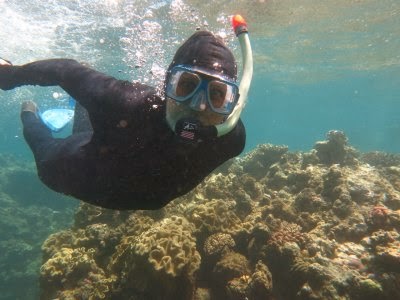
On March 15, Julian and I selected Wavelength Marine Charters for a full-day boat trip to the Outer Reef of the Great Barrier Reef from Port Douglas, Queensland. It was a good selection. It took about an hour and a half to reach the outer reef and we visited three different sites. There were two marine biologists on board who helped us identify corals, sea cucumbers, sea stars, crabs and fish. We were surprised to find a place where the reef was still in such pristine condition—many fragile corals with colorful fish ranging in size from three quarters of an inch to five feet from nose to tail.

Flickr slide show

Antarctic Exploration Huts

During our trip to the Ross Sea we were able to visit huts used by four different British Antarctic expeditions during a period known as the “heroic age” of exploration (1897-1917). In 1898, Carsten Borchgrevink led the Southern Cross Expedition (named after the ship he sailed) which was the first expedition to use dogs and sledges and the first to overwinter on the Antarctic continent. We saw the hut from our Zodiac rafts off Cape Adare near the entrance to the Ross Sea, but were unable to go ashore due to high waves crashing against a steep ice-covered shore.
Southern Cross Expedition huts
Adele penguins with steep beach at Cape Adare
At three other sites it was a rare privilege to see the expedition gear and personal effects of the men who mapped the coast line, conducted scientific research, reconnoitered routes and established depots of supplies for expeditions to the South Pole.
In 1901, the Discovery Expedition led by Robert Falcon Scott set up a base at the southern end of the Ross Sea (near the present American Antarctic base, McMurdo Station). The Discovery Hut is currently undergoing repair work to move it back onto a secure foundation where it had been dislodged due to heavy ice accumulation. Most of the artifacts have been removed temporarily until repairs are completed.
Discovery Hut at Hut Point during restoration
Inside Discovery Hut. A pendulum for scientific measurements was installed in the square opening in the floor. Boxes of dog biscuits are stacked to the ceiling
View from Hut Point showing Discovery Hut, a resupply ship and McMurdo Station in the background
Just behind the Discovery Hut at the top of a hill stands a cross in memory of George Vince, a member of the Discovery Expedition who perished when he slipped into a crevasse.
Overlooking McMurdo Station is Observation Hill where members of Scott’s ill-fated Terra Nova Expedition of 1910-12 searched daily in vain for Scott’s party upon their return from the South Pole.
Here we are climbing Observation Hill around 10:00 pm. We began our descent at 11:45 pm while it was still fully light out.
View of McMurdo station from Observation Hill
Antarctic sun at midnight on January 31, 2014
Ernest Shackleton in 1907 led the British Nimrod Expedition where he pioneered a route up onto the South Polar Plateau, reaching the Farthest South record of 97 miles from the Pole. We visited the Nimrod Expedition hut at Cape Royds.
Our trek to Shackleton’s Nimrod Expedition Hut at Cape Royds
Nimrod Hut, dog houses and supply boxes in the foreground
We took great pains to avoid transferring soil or vegetative material from one site to another, to avoid cross contamination.
Condiments used by Shackleton’s team
Joan Boothe is an expert on the Heroic Age of Antarctic expeditions. She seemed to know everything about the people, places and dates important to this era and she was a delight to have on board as a fellow passenger.
Inside the Nimrod hut
In 1910, Robert Falcon Scott set out on a second expedition to Antarctica, the Terra Nova Expedition, in an attempt to reach the South Pole via the route established by Ernest Shackleton. Scott built a second hut for the Terra Nova expedition at Cape Evans, not as far south as his original Discovery Hut (Ice conditions prevented him from reaching his original base).
Spending time inside the Terra Nova hut was a remarkable experience. The restoration work by the Antarctic Heritage Trust has been amazing  Shelves are stocked with tinned food, medicine and cookware. There are slabs of seal blubber (still not decomposed after a hundred years) ready to be boiled down for oil or carved up and made into stew. Reindeer hide sleeping bags lie on bunk beds. Assorted medicines and glassware for doing chemical analyses are arranged on work tables.
Terra Nova hut with Drygalski Ice Tongue in the background
Terra Nova hut at Cape Evans
Food stocks
Chemical glassware and reagents used for research
Food, cookware and utensils used by Scott’s expedition to the South Pole
Cynthia inside the Terra Nova hut
Slabs of blubber used for fuel and food
Skeleton of Siberian Pony used (without much success) by Scott’s Terra Nova Expedition
Boots worn by expedition party member
The Terra Nova hut was a prefabricated structure which was assembled and completed in January 1911, ready to be occupied during the Antarctic winter of April-September. Expedition team members began establishing supply depots on the ice in preparation for an attempt to reach the Pole the following spring.
An exploration party inadvertently came across a camp established by Roald Amundsen of Norway, who had originally set out leading an expedition to the North Pole, but then made an unannounced change of plans and headed to the South Pole instead. The competition between Amundsen and Scott to be the first to reach the Pole is a fascinating story recounted in several books.
Amundsen reached the South Pole on December 14, 1911 and returned without any casualties. Scott reached Pole 33 days later, but he and his team died on the return journey due to scurvy, starvation and severe cold.

Tasmanian Devils

The Tasmanian Devil is an amazing creature, a marsupial the size of a small dog. They like to sleep during the day, but they become active at about five minutes to 3:00 pm, which is feeding time at the Tasmanian Devil Conservation Park on the road to Port Arthur on the Tasman Peninsula.

Devils exhibit “communal feeding” behavior, which sounds like the kind of thing we would want to emulate. However, when you see how two devil brothers slash at each other’s faces and rip apart a wallaby carcass, you may want to reconsider.

Tasmanian Devil video

Tasmanian Devils are currently suffering from Devil facial tumor disease, a kind of cancer that is transmitted by physical contact between animals where cancer cells spread directly from open sores to facial lacerations. Something like 70% of Tasmanian Devils have perished since 1996 from this malady. The Conservation Park is trying to isolate its population on the Tasman Peninsula from devils on the rest of Tasmania and so far these efforts have been successful.

Adelie penguin behaviour

When spent a couple of hours at the Adelie penguin rookery on Ross Island in Antarctica and were able to observe all kinds of behavior–parading along single file from one end of the beach to the other, emerging from the water after feeding on fish, chicks waiting patiently for their parents to arrive with food, and adults being chased before finally feeding their chicks. Quite amusing.

The ones with white bellies have just come out of the water; those with dark bellies have been lying in penguin poo.

Video at http://www.flickr.com/photos/11790404@N02/13050744675/

David

The gifts keep coming

We spent two days at Okiwi Bay on the north end of the south island of New Zealand. This gift was the result of an invitation from Jeanette who sat in front of us on our flight from LA to Auckland. After David lifted her bag from the luggage bin as we deplaned, she invited us to visit. Upon arriving in New Zealand from Antarctica, we realized we had not overburdened ourselves with planning this portion of our adventure. Following our noses led us to Milford Sound on a very wet day, which allowed us to view sheets of waterfalls streaming down rocky bluffs. Getting up early the following morning, we sailed out into Milford Sound, a beautiful, long fiord with waterfalls coming down cliff faces. Then, as the sun emerged, we enjoyed some kayaking in the sound and viewing the sea life at the Deep Underwater Observatory (at a depth of 3o feet underwater). We followed this in the evening with a cave walk to view Glow Worms that glow in the dark like fire flies. They have a very interesting cycle indeed.
We followed this up with visiting Lake Tekapo and our amazing night of astronomy. We figured we had lost our opportunity to see Aurora of the south when we left Antarctica. But, oh no, there it was in all its colorful glory.
We spent a quiet evening with Trevor, a Servas host, in the small town of Cheviot. He took us for a lovely walk and shared the history of the area.
Traveling the roads here has been easy. Most roads are quiet two lane roads built along the contours of the land so it is continuous beautiful scenery, very much a feast for the eyes.
New Zealanders are warm, friendly, welcoming, helpful people. They seem always ready to extend a helpful hand as evidenced by our latest hostess, Jeanette who welcomed us as though we were family. Upon leaving her home yesterday, we spotted an Australian couple from our Antarctica trip walking along the street of Kaikoura. We spent a couple hours together at the local flight museum and may likely see them while we are in Australia.
Today’s delight was swimming with dusky dolphins. They are the acrobats of the sea and love to show off.  Up at 5 am, we got fitted with wet suits, flippers and masks and motored out into the ocean. After about half an hour, we found a group of about 100 dusky dolphins just waiting to play with us. Into the ocean we slipped making goofy sounds which brought them right up to us. It was an unbelievably sweet experience. Since dolphins are nocturnal, we caught up with them just after feeding and they had very high energy as you can see in David’s photos.
So for us, the lack of plans has brought many gifts and possibilities.
Cynthia

Southern Sky Astronomy Tour

On Wednesday night, February 19th, we joined a night-time astronomy tour sponsored by Earth & Sky. The University of Canterbury operates several telescopes at the summit of Mt John near Lake Tekapo and we had an opportunity to view several celestial objects through different telescopes. Located in the Mackenzie Basin far from city lights, Lake Tekapo has some of the darkest skies in the world and has been designated as an International Dark Sky Reserve.
We saw several objects that we cannot see in the northern sky, including the Magellanic Clouds, Alpha and Beta Centauri (the “pointer stars”), the Southern Cross, and the globular star cluster 47 Tucanae.
We were lucky not only that skies were clear, but that an aurora was visible that night as well. We could see greenish streaks and a reddish patch of light in the south. Cynthia and I appear in the group photo taken with the aurora as the backdrop.
Maki Yanagimachi, a very talented astrophotographeron the staff of Earth & Sky offered to take photographs for tour participants using their own digital SLR cameras. She collected half a dozen cameras, mounted them on a long aluminum bar attached to a tracking mount and proceeded to take several photos, including the Large Magellanic Cloud (LMC). The LMC is a sister galaxy of the Milky Way, but with only about 1% of its mass.
Maki also attached my camera to a telescope and took this photo of the moon.