Charming Chiang Mai

We are happy we connected with our Whidbey Island friend, Todd, in
Ayuthaya. As we are nearing the end of our journey, he was beginning
his. It was lovely to have this intersection for an afternoon, after
which we boarded a night bus for Chiang Mai in North Central Thailand.
Though we were on a luxury bus with reclining seats, a good night’s
sleep still eluded us.

We arrived in Chiang Mai grateful to have booked a room in Riverside
House, a small quiet bed and breakfast with a lovely garden. We were
about 15 minutes walk from the center and right on the river which
runs through the city.

After spending a quiet first day, we set out to explore. Chiang Mai is
absolutely loaded with temples and monasteries. I don’t think you can
walk more than two blocks in any direction without finding at least
one and often more. I was quite amused to come across one that had a
large Donald Duck among all the other animals staged in its garden. It
has surprised me to see a fair bit of kitschy stuff amongst the
buddhas. Plaster and plastic figures and plastic flowers abound in all
of Asia.

One of our must do’s was a Prison Massage. We read in our guidebook
that the women’s prison trained inmates about 6 months before release
in a number of skills. One of these skills is Thai massage. Upon
reaching a level of skill, they are able to work in the prison massage
shop and the money collected is saved for their release. We had great
massages and were put in some positions we hadn’t experienced before!
Once again, we felt great about where our tourist dollars were going
and that these women would leave prison with a way to earn a
livelihood.

The following day, we both took a Thai cooking class at an organic
farm in the countryside. We first had a brief visit to a market where
we were introduced to about 20 different kinds of rice.

At the farm, we found all the fresh ingredients that we would pound
into our green, red or yellow curry paste. Most of these ingredients
grow year-round in Thailand which gives the food it’s wonderful
freshness. Our teacher was a very charming and humorous Thai man, who,
while showing us traditional methods and ingredients, offered
encouragement to modify his recipes and make the food our own way with
the ingredients available to us when we returned home. David and I are
looking forward to giving it a try.

Ayuthaya

Ayuthaya is a city about 45 minutes north of Bangkok. It was the royal
capital of Siam from 1350 to 1767, before Thailand was established
with its capital at Bangkok.

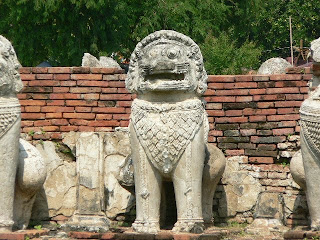
We spent three days there visiting some of the sights, including ruins
of temples (called Wats) and monuments. Most of these were built in
14th and 15th centuries and show both Hindu and Buddhist influences.
They are reminiscent of Angkor Wat in Cambodia.

What struck me is how many of these temples seem to have been built by
kings to accrue merit or for their own glorification. Several
monuments were built in recognition of victories in subduing other
peoples in warfare.

In fact, it seemed a bit incongruous to see so many statues of the
Buddha in places designed to honor persons with big egos and
questionable achievements.

Maybe we have just visited too many Buddhist temples on this trip. But
it also brings up questions I have about the interrelated concepts of
merit, karma, rebirth and reincarnation.

The idea of doing “holy” acts in order to build up one’s own store of
merit, with the idea that it will somehow help oneself after death
seems to me misguided. It’s the same disillusionment I felt growing up
with the idea that through good works, people can better their chances
of going to heaven rather than going to hell. Except in a metaphorical
sense, I just don’t buy it.

And then there are the concepts of karma and rebirth that I really
cannot get my mind around. I just don’t believe that any kind of
individual personality or identity persists after death, except among
the people who remember you. Don’t we have a responsibility to
recognize when we are engaged in wishful thinking and set this aside?

My own experience resonates much more closely with the Buddha’s
teaching of anatta– that there really is no “self” there. It seems
very simple and true. Why complicate it with endless conceptual webs
of “good” and “bad” karma, karmic connections, rebirth and
reincarnation? To me it just feels better to drop all that.

As an alternative to visiting lots of Buddhist temples in Thailand, I
decided to pick up a copy of the book, “Monk in the Mountain: Simple
lessons you can use from a Western Buddhist monk,” by Ajahn Sumano
Bhikkhu.

Sumano Bhikkhu was born in Chicago. In the mid-1960s, he attended
college and went to law school. He married and made a career in real
estate. Then in his mid thirties, he quit work, divorced and took up
his spiritual practice in the thudong lineage of Theravada Buddhism.

Since 1991, he has been living in a cave near Ubonratchathani in
eastern Thailand, following a strict regimen of meditation.

His book reflects some deep wisdom, springing from his meditation
practice. It’s a collection of questions from visitors to his cave and
his answers. The idea of karma is a key point in many of his
responses, and many of these are no doubt helpful.

But his response (p66) to a woman who as a child had suffered sexual
abuse by a male relative really stuck in my craw. He talked about the
possibility that in a previous lifetime, perhaps she had committed
some dastardly deed to this person, and that this was a process of
karma working itself out.

What nonsense!
(In my not-so-humble opinion)

The idea of karma as somehow providing just rewards for good or bad
deeds seems to me like pure fantasy.

I am reminded of an interesting exchange between Johannes, a sangha
member at our own Tahoma Monastery on Whidbey Island with our teacher,
Shodo Harada Roshi during a question and answer session a few years
back.

Johannes asked, “What is karma?”

Roshi replied, “It’s not part of Buddhism.”

!!!

I always remember that with a smile.

My Fears

Coming into the last week of our 18-week journey gives me an
opportunity to reflect on the various fears I’ve harbored along the
way, how I’ve tried to deal with them, and what’s actually come about.

Even before we left our home on Whidbey Island, I had plenty of time
to imagine all manner of disasters, calamities and misfortunes. It
seems that planning and fear go hand in hand– you try to anticipate
things that may go wrong, and attempt to minimize the risk of
consequences.

The first set of concerns had to do with the kora around Mt. Kailash,
which includes crossing a mountain pass at an elevation of 18,600 ft.
Any time a person goes that high, there is a danger of altitude
sickness, or hypothermia, or freezing of fingers or toes.

Altitude sickness is somewhat unpredictable and can occur even among
those who have been or similar or higher elevations before. The
recommended treatment is to descend to a lower altitude immediately,
but when the base of the mountain is at 15,000 feet, you can’t go
lower than that. In order to deal with this eventuality, I decided to
rent a Gamow bag to take along in case of emergency, but as it turned
out, neither Julian nor I had any significant difficulty with the
altitude.

With the perspective of hindsight, I would say that the Gamow bag was
unnecessary. [In fact, at the last minute our Tibetan guide, without
consulting us, didn’t bring the bag on the kora anyway.]

Both Julian and I were relatively fit and we ascended the mountain
more gradually than many others do. So while it was highly recommended
by our trekking agency, if I were to do it again, I would leave the
Gamow bag behind.

Hypothermia or frostbite are usually the result of winter storms that
can bring windy and cold conditions. We only had one night where the
temperature dropped below freezing, so there was never any danger of
frostbite on this trip.

I had heard stories of people being bitten by dogs in Tibet,
especially by the Tibetan Mastiff that can be particularly fearsome as
it tries to protect its territory. Our Tibetan guide in Lhasa
described one of his clients who got bitten when she went to pee
behind a nomad’s tent.

I had thought about trying to take along some pepper spray to have on
hand, but didn’t do so. As it turned out, we saw plenty of dogs in
Tibet, but they all seemed to ignore us as long as we ignored them. We
never felt in danger of being bitten by a dog.

I had also worried about having difficulty sleeping in Kathmandu or
Lhasa where there are often dogs that bark a lot at night. A Nepali
friend of ours, on a recent trip to Kathmandu had difficulty sleeping
almost every night due to barking dogs.

I took along some ear plugs and there were nights when there were
barking dogs, but the ear plugs had limited effectiveness. So I wasn’t
able to find a satisfactory remedy.

Insomnia is an issue I deal with more frequently as I grow older. It’s
not always easy to figure out why it happens when it does, though
noises can definitely keep me awake.

Certainly caffeine and alcohol contribute to the problem. I feel much
better and sleep better when I don’t have any caffeine after noon and
limit my intake of alcohol to no more than three drinks a week.

But sometimes, even without caffeine or alcohol I find myself lying
awake, feeling in need of sleep, but not feeling sleepy. The best
remedy for this I’ve found is to get up and sit zazen. Usually 30-45
minutes of zazen will quiet my mind enough for me to fall asleep.
Sometimes, I fall asleep soon after going to bed, then wake up around
midnight or 2:00 am with insomnia. If I do some meditation then, it
seems to help me to go back to bed and sleep.

Sometimes, my insomnia is associated with muscle cramps. If I have
over-exerted a set of muscles during the day, then for some reason, at
night those muscles will cramp up and give me a “charley horse”.

I’ve found that if I make a point of drinking lots of water, sometimes
fortified with a calcium tablet, the cramps will go away. I feared
that muscle cramps would be a problem on this trip, especially with
the mountain trekking, but as it turned out, I never had any problem
with this at all.

Food and water-bourne illness was also something I was concerned
about. When I was living in Nepal in the early 70s, I was extremely
cautious about food and water. As advised by Peace Corps staff, I
never ate any raw salads, except when the vegetables had been soaked
in a solution of iodized water. And I never drank any water that had
not been either boiled or treated with iodine. These were clearly
effective measures then, as Westerners, who drank untreated water or
uncooked food, often came down with diarrhea, giardia, amoebic
dysentary, hepatitis or typhoid fever. So before we left, I was
prepared to follow the same regimen.

On this trip we carried a UV water purifier (Steri-Pen) and used it to
treat the tap water we used for teeth brushing and some drinking. For
drinking water in restaurants, we usually purchased bottled water.
However, I also drank well water (for the first time) from homes in
Nepal where we were invited to share meals. Neither Cynthia nor I
suffered suffered any ill effects.
We’ve been happily surprised that in all of our travel through these
several countries, neither one of use has had any stomach problems at
all.

In all previous trips to Nepal, we have taken medication to prevent
malaria. There are lots of mosquitoes, especially in the Terai, where
we would be going to visit our friends in Taulihawa. But this time, we
decided to forego the malaria medication and just bring along insect
repellent.

Also, we knew that dengue fever is common in Cambodia and Thailand. A
friend of ours came down with a nasty case of dengue fever in Thailand
recently. But since there is no vaccine or prophylactic for dengue
fever, here too we were dependent on insect repellent, mosquito coils
and mosquito nets for sleeping.

I’m definitely not Buddhist when it comes to mosquitoes or the
microbes in the blood that are responsible for malaria and dengue
fever. Not only do I think it is necessary to kill those living
organisms that cause illness in our bodies, but that it is perfectly
reasonable to kill mosquitoes that land on our skin or hover around
our bodies attempting to.
I remember at a meditation retreat on Whidbey Island, during one
particular round of zazen, I had mosquitoes land right on my nose and
forehead. As they bit me, I kept telling myself, “There is no malaria
on Whidbey Island. THERE IS NO MALARIA ON WHIDBEY!!” I could barely
resist slapping the insects, but somehow the peer pressure of sitting
motionless kept me from doing so. But here in the tropics where there
IS malaria and dengue fever, I’m okay with slapping mosquitoes.

I just wish I knew how so many people seem to be able to live here in
the tropics with mosquitoes all around. They are certainly not using
insect repellent, and you don’t see them killing many by slapping
them. Occasionally, people do sleep under mosquito nets. I do know
that the incidence of malaria and dengue fever are both high in this
part of the world, but I guess my question is, why isn’t EVERYONE
sick? I just don’t know.

In fact, the not knowing seems to be a big part of all these fears.
The not knowing is a given when you travel. It seems that an essential
part of venturing out is acceptance of the unknown.

It also helps when you travel with a partner who can help balance the
fear and the fearlessness. Often when I am feeling a bit vulnerable or
worrisome, Cynthia is the one who figuratively (or sometimes
literally) gives me a shake to make me snap out it. Other times, when
she starts to indulge in a bit too much speculation, I am the one to
be decisive. It actually works out quite well.

Also, it helps to have so many friends who wished us well in our
travels. We feel the support connection all the time. And I still
carry the tiger eye amulet in my pocket everyday as a reminder of that
connection.

Sea and Jungle of southern Thailand

I had heard that southern Thailand had some nice beaches and good
snorkeling sites, so we decided to catch a flight to Phuket. From
there we took a taxi north to Khao Lak, a popular takeoff point for
trips to the Similan Islands Marine National Park.

The Similan Islands are 60 km west of Khao Lak, in the Andaman Sea.
The nine islands of the park are surrounded by protected bays and
coral reefs that are rich with sea life. The beaches are a soft, very
fine pure white sand the consistency of sugar. There is some evidence
of damage to coral reefs due to the tsunami of December, 2004. It hit
this part of Thailand pretty hard. But there is new coral growing on
the rubble of the old and there are plenty of fish making their homes
here.

We saw thousands of fish, from 18-inch blue and green parrot fish to
schools of iridescent blue minnows. I saw a sea snake for the first
time, a reptile about 3 ft long that crawls along the bottom like a
land snake and periodically rises to the surface to take a breath of
air.

Cynthia and I had some very personal encounters with a large curious
sea turtle who swam within inches of our faces before diving below us.

One of the most interesting creatures I saw looked like a jellyfish —
roughly cylindrical in shape, maybe three inches across and 2 inches
top to bottom. The thing that caught my attention was the flashing
lights inside the animal — looked like violet LED lights going on and
off, similar to a firefly, but less regular. I have never heard of
blinking jellyfish before, but I have heard of bioluminescent
jellyfish that can glow. So I need to research this a bit more before
I know whether I’ve come across a new species hitherto unknown to
science.

It turned out that we were diving at the time of a full moon and this
is when baby jellyfish, literally millions of them, each about a
quarter of an inch across rise to the surface in a big cloud. I had
been wearing a silk undershirt to protect myself from the sun but I
suspect it also served to trap baby jellyfish, who, not too happy
about being trapped, naturally gave the offending piece of flesh a
tiny sting. It felt like a slight tingling across my back. So now,
three days later, my back and shoulders are covered with little
itching red spots, slowly healing.

After returning from the snorkeling trip, we decided it was time for
the jungle. So we headed off for a two-day trip to Khao Sok National
Park.

On the way to the park, we stopped at a rubber tree plantation at the
side of the road where a worker was busy collecting the latex that
drips from the trees. Six days a week, after the monsoon season,
workers start around midnight (or before for especially large
plantations) carefully cutting away by hand a strip of bark on the
rubber tree, which then starts to “bleed”. The rivulets of latex flow
into a coconut shell attached to the side of the tree.

By morning, the collecting shells are emptied into shallow trays where
the latex starts to harden. After a few hours, the chunks of latex are
removed from the trays and passed through a wringer (like the wringer
on early washing machines, for those of you fortunate enough to be
able to remember that far back) to remove the excess water.

After running through the ringer, the piece of latex is 18″ X 36″,
about half an inch thick, ready to be sold by the farmer who earns
about $2 per kilogram.

Khao Sok Lake is a large lake that recently formed after construction
of a dam and a hydroelectric generating station. The lake is
surrounded by huge limestone cliffs and dense tropical rainforest.
It’s a fantastic place to just sit quietly and listen to the sounds.
Birds, monkeys and many creatures you can only imagine. It rains
frequently, as you would expect, but the rain is soft and warm and you
realize there really isn’t any reason to try to stay dry.

Our latest slideshows:

Snorkeling
http://www.flickr.com/photos/11790404@N02/sets/72157622634027761/show/

Rubber Production
http://www.flickr.com/photos/11790404@N02/sets/72157622758272662/show/

Khao Sok Lake
http://www.flickr.com/photos/11790404@N02/sets/72157622634142565/show/

Limestone Cave
http://www.flickr.com/photos/11790404@N02/sets/72157622634046917/show/

Time for a Vacation

This week in southern Thailand has really felt like rest and
relaxation. It seems we needed a break from our pilgrimage.

David found a somewhat isolated place, Poseiden Bungalows, which also
runs three day live-aboard snorkeling trips out to the Similan Islands
which are about four hours off the coast of Thailand (60 km). After a
few nights in the bungalow and a couple of days getting used to the
warm water of the Andaman Sea, we along with 13 others climbed aboard
and headed out to sea. On the way out we saw a minke whale and flying
fish. We went to about three different snorkeling spots that
afternoon.

We are right on the cusp between monsoon season and high (tourist)
season which is great because it isn’t yet crowded, though the weather
can be somewhat unpredictable. Some places had quite a bit of wave
action and others a strong current. Some were blessed with both and a
few had quiet water so that one could focus completely on the rich and
colorful sea life. We swam with very friendly, very large sea turtles
and an electric jelly fish as well as many angel fish, sergeant major
fish, a water snake, parrot fish, unicorn fish, trigger fish and many
others.

David swam at each of the 10 snorkel stops but I passed on a couple
that seemed particularly challenging.

We were all exploring one of the islands, when the winds really picked
up and the waves combined with the wind made it impossible for our
dingy to safely get to shore to pick us up. As we watched, conditions
continued to deteriorate. Fortunately, we were on an island in the
tropics and knew we would survive the elements if we were stranded
overnight. Even more fortunately, however, we were on the island that
houses the Navy Rescue team for these Islands. They saw our
predicament and came to our rescue with their large heavy duty pontoon
boat.

When we got out to our boat, however, our captain and the captain of
the rescue boat realized that the sea was too rough for us to move
directly from one boat to the other so we had to jump out of the raft
and our crew pulled us in with a rope. We all made the transfer
safely, cheered the Thai Navy rescue team, our own very competent crew
and set down to another Thai feast that the cook and her assistant
prepared in her closet of a kitchen amidst the storm and the rescue
operation.

The crew, the guide and the other 13 snorkelers were great to get to
know. It was a very international group with at least 8 nationalities
represented.

We returned to our bungalow for a night, then headed out to the jungle
which is about two hours away. We stayed in a bamboo hut on a raft in
a huge lake surrounded by jungles and limestone mountains. It was
gorgeous and full of exotic sounds. We were able to kayak along the
shore and, thanks to our guide’s sharp eye, observe monitor lizards
and langur monkeys, several long tailed macaque, and an iguana. As
evening came, we saw about 15 gibbon monkeys gathering in one tree for
the night.

There was quite a symphony of bird song in the morning as David and I
went for an early morning paddle in a soft warm rain. As we were
having our first coffee, we saw a pair of great hornbills fly above us
and land in a tree and take off again. They are very awkward flyers
and are reminiscent of pterodactyls.

Later in the day we did a short trek with our guide, a couple from
Germany and a Japanese woman. We went over a pass to another lake,
then into a cave filled by stalactites and stalagmites and formations
like none that we had ever seen before. The cave was only discovered
5 years ago and is in quite pristine condition since it is difficult
to get to.

We are back in the bungalow and having spent the morning lounging on
the beach, will have our last evening in this sweet place before we
head to Bangkok to meet our friend Todd and see what unfolds in our
final 10 days.