Thursday, Sep 10
Today we drove from Taklakot to Chiu Gompa on Lake Manasarovar. This is the start of our kora, a circumambulation of the sacred mountain Kailash, which is an important devotional practice by Tibetan Buddhist pilgrims.

The road is fully paved from Sera where we first entered Tibet up to Darchen where we go tomorrow. The asphalt road was completed just last year. We stayed in a hotel near the lake. They charge batteries using their solar panels during the day and then each hotel room receives a charged battery, which you connect to a fluorescent lamp with alligator clips.
We walked up the hill to Chiu Gompa and saw an alter devoted to Padmasambhava and a shrine room. Much of the monastery has been rebuilt fairly recently.

We visited a hot springs and checked out a couple of bathing facilities. We decided we would try a hot bath the next morning.
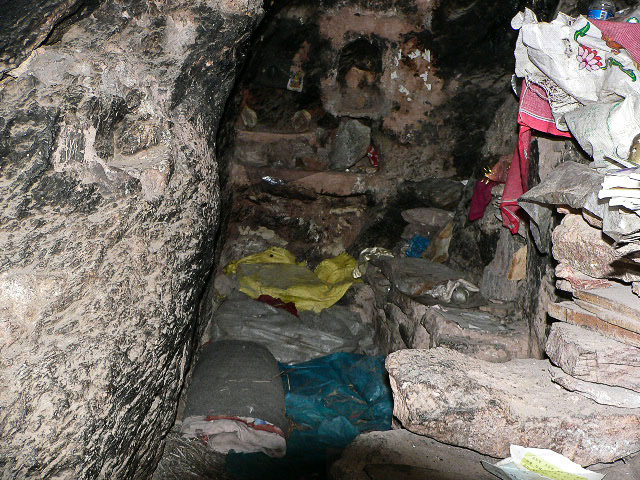
In the afternoon, we walked up to some hermits’ caves. We were surprised to find one with bedding, books and other signs of recent habitation.

Friday, Sep 11


We woke to clear skies and a fabulous view of Mt. Kailash just before sunrise. Lots of snowy peaks around the horizon.

After breakfast (buckwheat pancakes again, this time spiced up a bit with chunks of pear), We packed up the car and drove to one of the baths. There were three other people waiting to take baths, but no sign of the proprietor. Mingma called the phone number painted on the wall and someone said they would be right over. Soon each of the five of us were in our own private bath, waiting for the wooden tub to fill. But the flow was so little that we only managed to fill about 2 inches in the tub. That was enough for a bath, using the cup provided. It felt good to have a bath, our second since arriving in Tibet.

We then drove to Darchen, about a 2-hour drive. There were some great views of Mt. Kailash along the way. We checked into a guesthouse and went out for some lunch. Not that we were particularly hungry yet, but we ate a hearty lunch, knowing that we would burn it all off tomorrow when we start the kora.

In the afternoon, we hiked up to the Gyangdrak Gompa, a 5-mile trek up to just over 16,000 ft. This was a good bit of additional acclimatization and training for tomorrow. Our destination is just slightly higher than we reached today.
We returned to the guesthouse and started packing our gear. It looks like we can reduce our things enough to hire just two porters and not deal with yaks at all.
So we’re back on schedule with our original itinerary; by advancing a bit more quickly, we have made up the time lost due to canceled flights.
Saturday, Sep 12
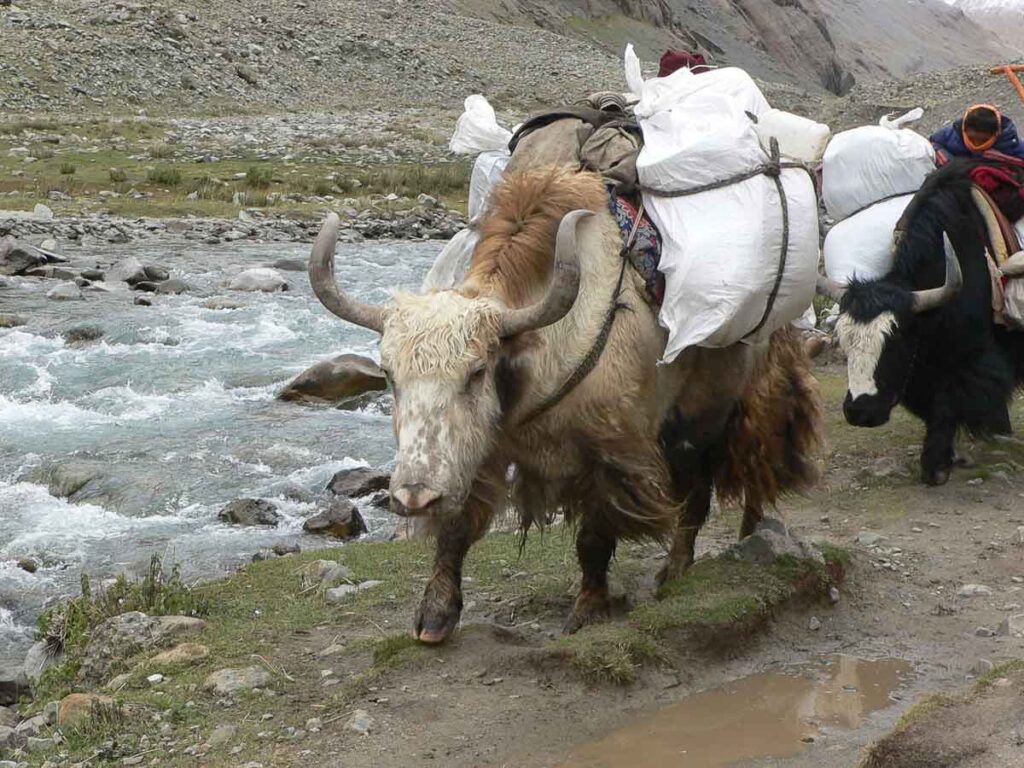
Today we started the kora. Mingma had arranged for two porters to carry our gear, instead of hiring a yak man to guide a yak.
We carefully set aside the things we wanted our porters to carry and the things to be left behind. In addition to our personal things, I had explained to Mingma that we wanted to have the Gamow bag carried on the kora so it would be available in case any one of us experienced altitude sickness.
There was a group of about 20 Russians from St. Petersburg who were setting out about the same time. They had maybe 15 or 20 yaks for their gear.
The weather was cloudy so we only got glimpses of the base of Mt. Kailash from the first prostration point, Chag-Tsal-Gang. Saw the thousands of prayer flags at Darpoche, where the big Saga Dewa Festival is held each year on the full moon day of May or June.

Here also, we saw the sky burial site, which is no longer used — apparently there are too few vultures and too many dogs.
We encountered large numbers of India pilgrims returning on horseback from Dira Phug, Monastery having turned back after hearing that there was snow on Dolma La pass. One person told us the pass was “closed” due to snow.


Julian and I were both determined to forge ahead, of course. We figured we both have enough mountaineering experience with snow and ice that we weren’t all that concerned. Besides, at the bath yesterday, we met a German woman, Evita who had just returned after completing the kora and while she described some snow, it wasn’t anything that made it too difficult to cross.
We arrived at a newly constructed guest house just across the river from the Dira Phug Monastery around 3:00 pm
Just as we were arriving I was surprised to hear a Land Rover coming up behind me. I didn’t realize that it was possible to drive all the way up here. It went on to the monastery. Later we learned that our two porters and our two bags were on that vehicle– they rode all the way up here with their loads. I guess that was Mingma’s plan all along — he had mentioned sending our gear ahead with the porters on a vehicle. I just hadn’t realized this meant they would drive all the way to our day’s destination.
Julian was keen on walking up to the Kangjan Glacier, so after resting for an hour, he and Lal and I headed on up. Julian went on ahead, reaching a point 17,400 ft, according to the altimeter on his watch. I wasn’t moving as fast, so at about 17,000 feet, I decided to just sit down and rest and wait for Julian and Lal to return. It was a pleasant place to sit by a mountain creek.
We returned to the guesthouse around 6:30pm and took a rest. Climbing up to 17,000 ft today was probably good for acclimatization for tomorrow when we plan to cross the Dolma La pass at 18,400 ft. We were too tired to visit the Dira Phug Monastery.
Sunday, Sep 13
Today we rose early, at 7:30am. Here in western Tibet, on the same time zone as Beijing, everything happens at later clock times. The sun rises around 8:00am.
Today the sky was clear at sunrise. In fact, the weather today turned out to be the best weather we have had on the entire trip so far– calm and sunny.
We began walking around 8:45am. It was cold– below freezing. Many of the streams and rivulets were iced over or frozen solid. We left about the same time as the Russians, but gradually overtook them.
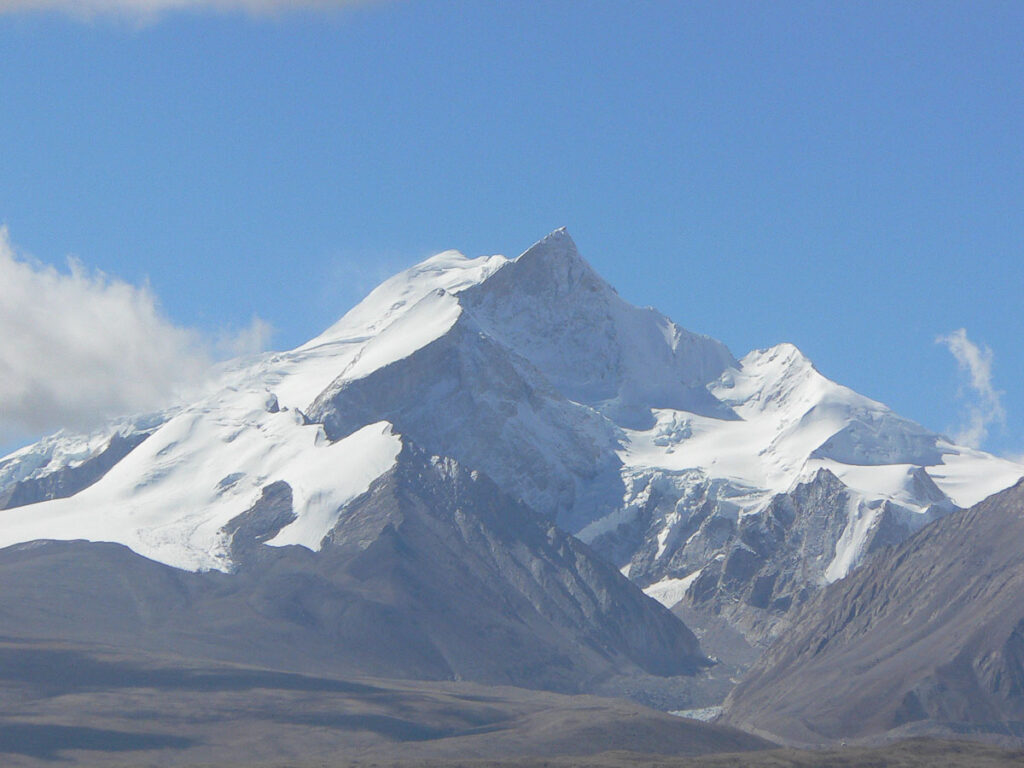
The guide for the Russians had a need to two additional porters and had plenty of yaks, so he and Mingma arranged to have our gear loaded on yaks while our two porters took a different job; I think they returned to Darchen.
I soon found that I had to adjust my pace downward at this altitude. The first part of the trail was relatively steep and I moved slowly. Then it leveled out and I could pick up the pace a bit, but still kept it relatively slow. Julian meanwhile forged ahead at his 25-year-old pace, with Mingma (28 and Tibetan). Lal and I didn’t see Julian again until we reached Dolma La pass.
There are all kinds of sacred rocks along the way. One is a place for people to leave something behind (representing their former selves) — clothing, a drop of blood or a lock of hair.

There are rocks with “footprints” of Milarepa. There is a “sin-testing rock” which you can try to crawl under to test your sins. It was too far off the trail for us to make use of, however.
As we approached Dolma La pass around noon, I was advancing very very slowly, breathing a couple of times for each step. The pass is marked with thousands of prayer flags, many attached to a sacred rock depicting the goddess Tara.
The site is rather trashy, with discarded packaging scattered all over the place. Discarded pop cans, fruit juice boxes, beer bottles and other bits of paper and plastic are a huge problem here. Neither the local Tibetans nor most of the pilgrims seem to have any concern about the garbage-dump-like character of the place that results from just tossing aside trash without looking for a proper place to discard it.
Even our Tibetan guide, Mingma had tossed his fruit juice box under a rock where we had been taking a break. Julian explained to him that in America we never do this and insisted that we carry the trash with us.
At Dolma La Pass, Julian was there waiting for us, having arrived about 45 minutes earlier.


Mingma had decided to press on to Zutul-puk Monastery in order to secure a room for us at the guesthouse.
We sat down to rest and have part of our lunch. We would eat the rest later after we reached a lower elevation. Large ravens and smaller birds helped pick up apple cores and food scraps.
A porter came up to us and asked for some food. Lal gave him a package of biscuits. The porter removed the wrapper and immediately tossed it on the ground. I couldn’t stand to see him discard his trash like this, and, inspired by Julian, I immediately objected and told him to give me the wrapper to carry down.
We headed on down, a fairly steep descent at first. Then came a long long relatively flat trail along a river valley toward our day’s destination, the Zutul-puk Monastery.
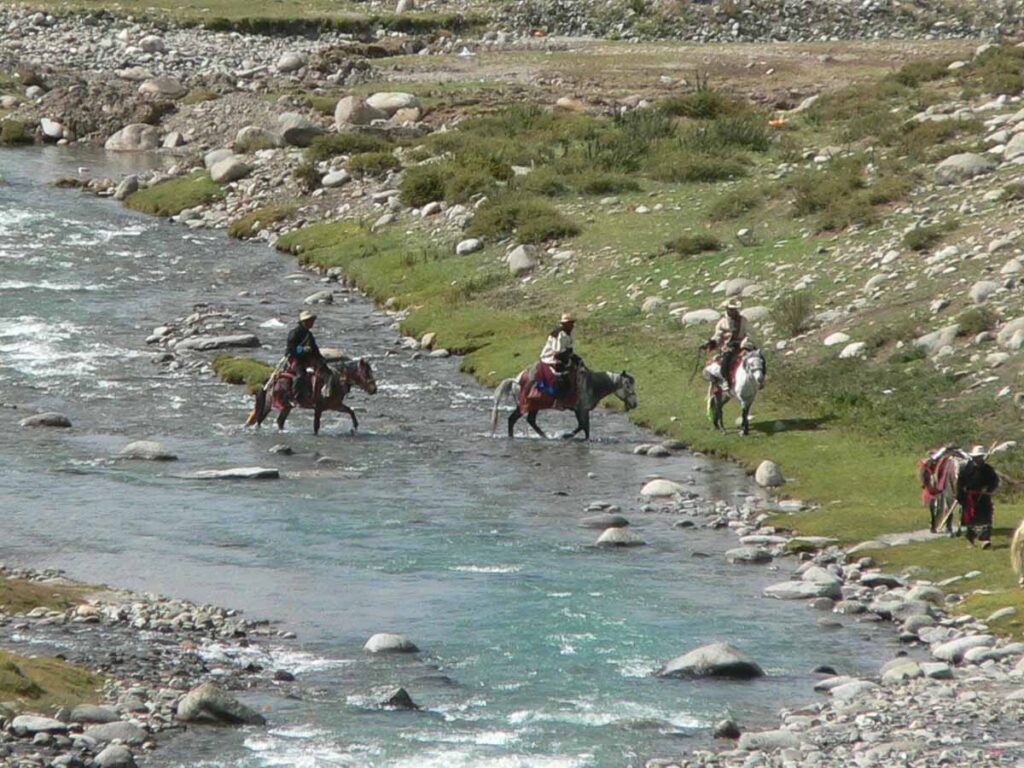
At one point we found ourselves on the wrong side of a river and we searched for a way to cross it– each point we checked seemed to be just a little too wide between stepping rocks. Lal had remembered that there was a primitive bridge farther down the river, but when we arrived there, the bridge was gone.
So the only alternative was to remove our boots and wade across the river in bare feet. Lal found a suitable place. Julian proceeded to cross on his own carrying his own pack. I accepted Lal’s offer to carry my pack and hold my hand as we crossed together. Rather cold, but not lasting too long. I’m glad we each had our walking poles for stability on the slippery rocks.
We reached the guesthouse at the Zutul-puk Monastery around 5:30 pm and immediately took rest in the rooms that Mingma had arranged. Mingma told us he was going to head on down to Darchen for the night, another 3 hour walk. I was glad to take a break at this point.
I must say, it feels really good to have crossed the pass with no mishaps. Neither Julian nor I have felt any nausea and while we’ve felt just a bit of borderline headache during heavy exertion at high altitude, neither of us has had a real headache.
In fact, we haven’t had any intestinal problems either, save Julian’s brief discomfort after eating soup prepared from a mix which contained wheat noodles. His gut reacted adversely to the gluten. Other than that, we’ve both been healthy.


Monday, Sep 14
Lal, Julian and I checked out the Zutul-puk Monastery first thing in the morning, before breakfast. It was a good time to visit, as one of the monks was doing his morning chanting.
After breakfast we set out again for the third leg of the kora.
We packed up our gear for the yaks to carry on down and at this point we realized that there was only one bag and the Gamow bag was not with us. In fact, it had never left Darchen! Lal explained that Mingma had decided to leave it behind because the Russian group was carrying one and he figured if we needed one we could use theirs! Well, fortunately, no one needed to use it, but it seemed a bit devious on the part of our Tibetan guide to make this decision without informing me, especially as I had asked him specifically to send it along.
We left around 10:00 am. The walk was fairly flat all the way to Trungto. This is where vehicles wait to pick up their clients and where yaks are unloaded. It’s where most people end their kora, though it’s still 4 km short of Darchen.
Julian was intent on completing the full circuit back to Darchen. The road to Darchen is flat and the 4 km goes pretty quickly. Lal has done the kora about 16 times and this is the first time he has come across anyone who has wanted to forego the ride in a vehicle back to Darchen. But he was happy to join us in our walk back to our original starting point. We arrived around 2:00pm
We stopped for lunch in a restaurant in Darchen and then got in our vehicle for the drive to the northeast corner of Lake Manasarovar. There is a camp here with semi-permanent tents set up for pilgrims. They also have rooms in a guesthouse, but Julian and I thought we would like to try out a tent. There are 8 beds in here, but with a high roof, it looks like it will be quite comfortable.
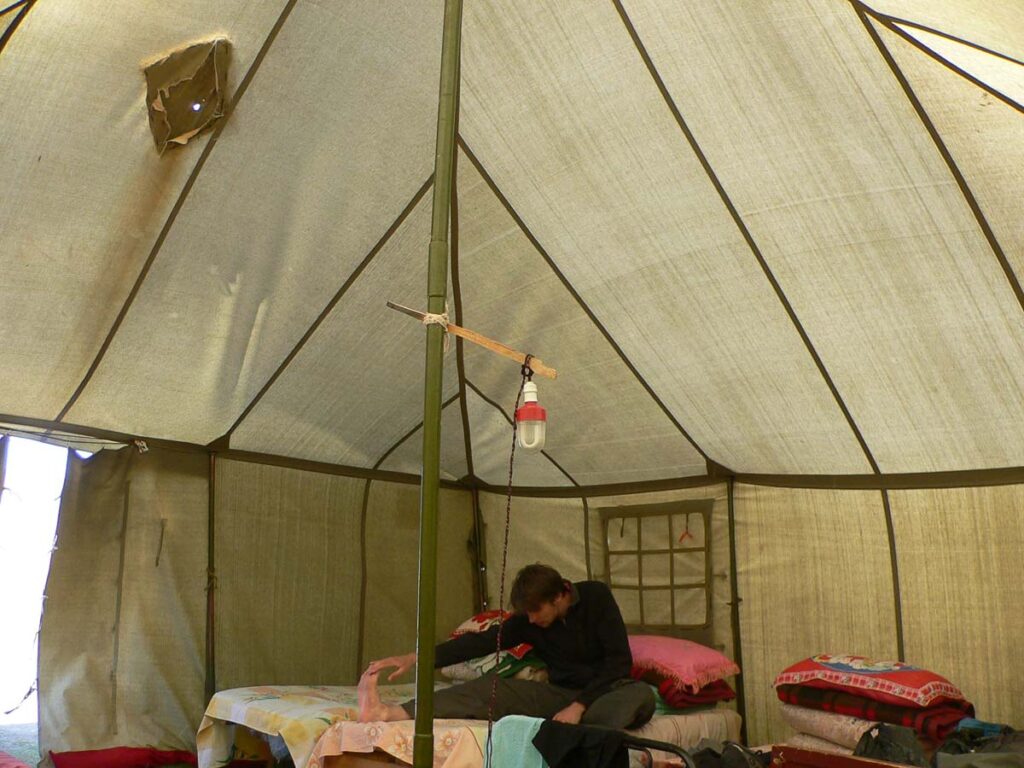
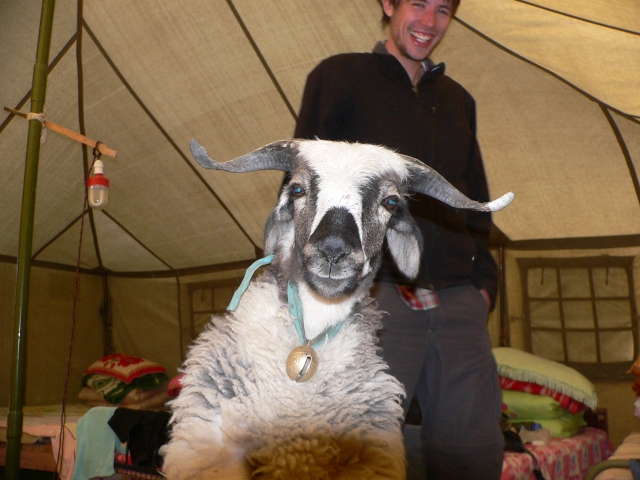
As we were sleeping is this tent, a goat wandered in, unbeknownst to us. I didn’t expect any problem leaving my tooth guard on the floor overnight, but alas, when I woke the tooth guard was gone–this goat must have eaten it!
After leaving our things in the tent, we drove off to Seralung Gompa, another monastery that was destroyed during the Cultural Revolution and rebuilt since. This one was rebuilt in the 1980s, but it looks older than that. The thankas and murals look like they’ve been around for 100 years at least, but things seem to age more quickly around here.
Since we only got about 4 hours of hiking in today and Julian is training for a Marathon in November, he decided to go for a run. He was amazed that he could actually run at an elevation of 15,000 feet. Now he’s taking a bath in the river, which is reputed to have “warm” water. We’ll see what he thinks when he gets back.
Well, Julian says that “warm” is not a good descriptive term for the river water, but he’s glad he had a chance to wash up after the run anyway.

Tomorrow we do some serious driving. While our itinerary has a destination of Paryang, Mingma hopes we can make it to Saga, which may take 10 hours or more. If we reach Saga, that will be about half way to Kathmandu. At this point, I’m eager to get back to Kathmandu and I’m hoping that Julian will have at least an extra day, maybe too to be with Cynthia before he has to head back to Seattle on Sunday.


hello David…..I have a question….how did u go to the manas sarovar(which places did u touch in india while reaching there)?…..i am planning to go to Manas Sarovar u see….so can u throw some light plz?
Sandip Datta, India