David and I have participated in numerous activities here in the Shark Bay area including viewing the stromatolites at Hamelin Pool, visiting Shell Beach—a huge beach consisting entirely of tiny shells, some of which have been cemented into beautiful blocks that once served as primary building material, seeing dolphins being hand fed from the beach at Monkey Mia, visiting a research aquarium powered by the sun, and spending an afternoon searching for marine life aboard the Shotover, once the fastest sailing catamaran in the southern hemisphere.
My favorite day, however, was spent with Darren “Capes” Capewell, an aboriginal man who has a gift for sharing his deep connection with place, or as he would say with ‘country’. Arriving at the Francois Peron National Park, we stopped to pick up a handful of red sand and let it run through our hands, offered gratitude to this land. As we drove into the reserve, Capes was constantly looking about, stopping to show us the tracks of emu, kangaroos, wallabies and wallaroos. To us all the short scrub looked the same, but Capes could identify different species. He would dash out a few feet from the truck and come back with a leaf shaped exactly like an emu track or a bush bananas, an edible fruit about 2” long you could eat the whole thing, peal and all – quite a refreshing taste – or roast the seeds. The white sap that oozed out was used as an antiseptic by the aboriginal people. They have known for millennia how to use what is at hand.
 |
| Mother and baby wallaroos (euros) |
 |
| Traveling on the deep sandy roads of Francois Peron National Park requires 4WD vehicles with reduced air pressure in the tires. Here “Capes” Capewell lets out some air while Bala and his friend Elena look on. |
 |
| The road to Big Lagoon is 10 km of deep soft sand |
Arriving at a huge lagoon surrounded by red hills, we gathered the white sand of the beach and threw it into the water, giving thanks for the bounty. Soon big black clouds rolled over and just as we set out in our kayaks, rain poured down, soaking us in minutes. It was the first rain seen here in five months and though brief, was welcome. The sun came out and we were warmed and dry again by the time we reached the other side of the lagoon.
 |
| Our kayaks ready to launch |
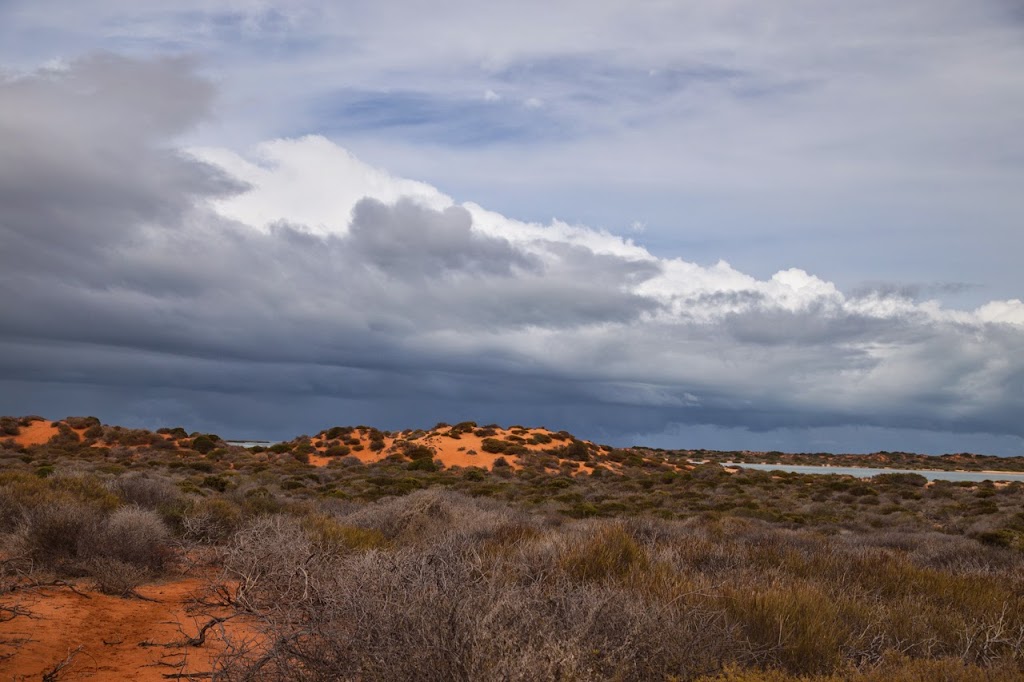 |
| Rain clouds rolling in just as we are ready to launch |
Capes handed us reels of fishing line rigged with a lead weight and a hook baited with octopus. He and his nephew Bala each had homemade fishing spears. Wearing water shoes we walked carefully out into the water aware that this was also the home of sea snakes, sharks, eels and sting rays. When I was at about waist level I felt a tug on my line. Capes urged me to reel it in. I was in wonder that just dropping a line with a hook could actually result in catching lunch for us. It was a beautiful black snapper. Bala caught a couple more with the small spear he had made so we all enjoyed a delicious lunch of very fresh fish, for which we gave thanks, and salad.
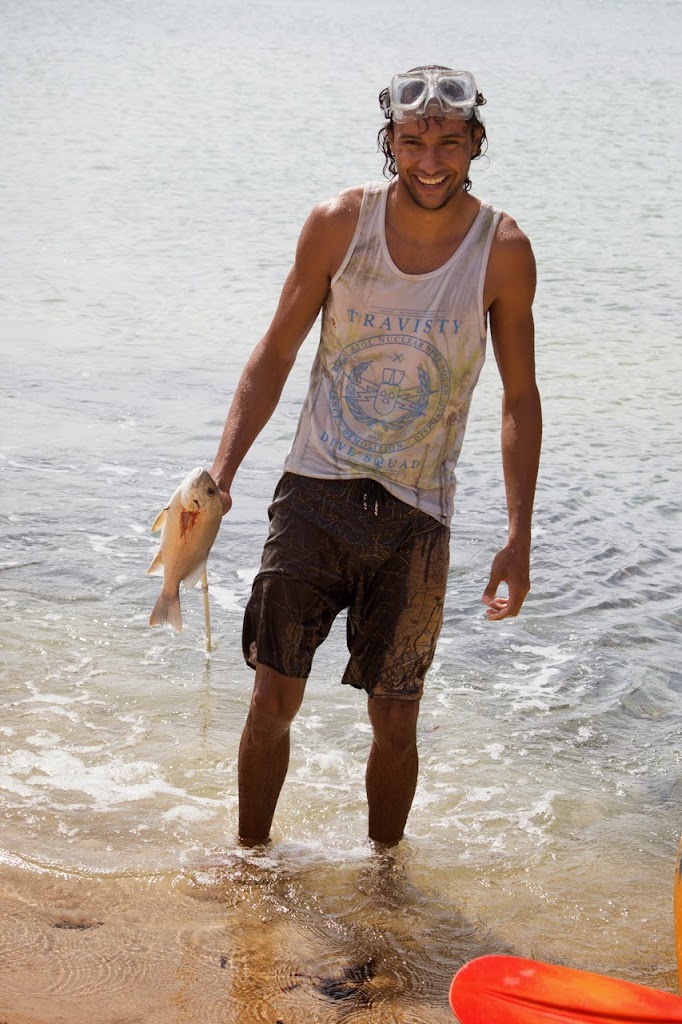 |
| Bala with a fish he speared |
 |
| The black snapper I caught without a pole |
 |
| Our first fish of the grill for lunch |
At the end of the day, we all climbed into a natural hot water pool and soaked as Capes shared with us that the Aboriginal people refer to stromatolites as their oldest ancestors. (This reminded me of the aboriginal man I spent several hours with on the other side of Australia in Mossman rainforest who knew his ancestors to be the oldest trees and rocks). The Aboriginals do not have a concept of owning things or land, but have a powerful sense of community which is the source of well-being. While this did not serve them well while explorers, settlers and immigrants came in claiming huge swaths of land for ownership, it is serves them now as they reclaim their heritage and extend their orally communicated laws and ways of governing to the next generation.
Cynthia
