On the eve of the Mt Kailash trip

Julian and I are packed up for our trip to Mt Kailash. Cynthia will be staying with the family of Deepak Mohat, owner of Adventure Thirdpole Trekking. His wife, Lalu was a former Peace Corps language instructor before the Peace Corps pulled out of Nepal in 2004. They have two children, a girl 8 and a boy 19. Cynthia is looking forward to living with the family and learning some Nepali.
Julian and I fly to Nepalgunj tomorrow, then Simikot the next day, where we begin our trek to the Tibet border, then on to Lake Manasarovar and Mt. Kailash.
When we arrived in Nepal, my Blackberry was unable to connect to Nepal Telecom, so I called AT&T. They had me remove the SIM card and reinsert it, which I did. Now, I am unable to use the Blackberry for communication at all. I get messages about “Iniialization Failed”. I suspect I will have to reinstall the operating system on the Blackberry. But no time for that now.
So for the next three weeks, there will be a lull in our blog postings — Cynthia may post some entries, but there won’t be any photos until Julian and I have returned to Kathmandu on about September 19.
Thank you to all you readers who motivate us to keep in touch.
David

The Feeling of Occupation

Leaving Gyanste a couple mornings ago, a caravan of at least a dozen large military trucks loaded with soldiers passed.  Our guide thought they might be headed to the border with India at Darjeeling.  About an hour later, our car was stopped by soldiers. Several ran further along the road while one remained beside us with his finger on his rifle trigger. Another group of soldiers was further ahead of us.
 
Our guide tried to ask what was happening and he was told not to ask and not to watch. After about ten minutes and some shouting back and forth among groups, the soldiers started heading back to their vehicles. We were told they would signal when we could move.  After 15 – 20 large trucks passed us heading the other way, we were able to move again.
 
I could sense the responsibility our guide felt for us, his feeling of helplessness in this, his own country. Street corners are controlled by Chinese military as are open air markets and the surrounding roof tops. The old part of cities which are largely Tibetan have survailance cameras. There is no doubt that the Tibetans are treated as second class citizens. Educations is all in Chinese with Tibetan taught as a foreign language. The number of monks at any of the restored monasteries is controlled by the Chinese and is just a handfull of the number who previously became monks. Restoration of monasteries destroyed during the Cultural Revolution, as in mainland China, comes from donations from individuals, not the government though 90% of the entry fee to visit monasteries goes to the Chinese government, thus becoming cash cows for them. It is difficult for Tibetans to get passports and thus travel freely.
 
The Tibetans way of life is strongly identified with their form of Buddhism and in spite of attemps through the Cultural Revolution, it remains the central focus of life for many Tibetans. We witness thier devotion everywhere we go.
 
The Chinese have contributed much that has modernized Tibet: an improved road system, better water, improved farming methods, hydro power, promotion of tourism. Most of this has come from the top down with no consultation with the Tibetans, which has resulted in changes to a landscape that they have cared for and regarded as sacred for centuries. Undoubtedly, most of these changes will not be reversed.  The best we can hope for is that the Tibetans will eventually receive an equal voice and receive the full rights of citizenship.
 
This experience gave us a token feeling of what it must be like for populations in countries that the US has occupied in the name of democracy and liberation.

Yungdrungling Monastery

When we read the description of Yungdrungling Monastery in our Lonely Planet guidebook, we asked our guide if we could possibly visit there on our way back to Lhasa, even though it was not on our original itinerary. He had never been there but was willing to give it a try.
The reason it sounded interesting is that this was a Bon monastery, not a Buddhist monastery. Bon was the religion of the Tibetan people before Buddhism arrived in the 8th century.
We expected to find something very different from what we had seen in Buddhist monasteries and temples, but surprisingly, this monastery had much in common with them.
According to “The History of Bon” in Lonely Planet (p. 68),
“Bon has its deepest roots in the earliest religious beliefs of the Tibetan people. Centered on an animist faith shared by all central Asian peoples, religious expression took the form of spells, talismans, oaths, incantations, ritual drumming and sacrifices. Rituals often revolved around an individual who mediated between humans and the spirit world.
 …
“Bon is thought to have its geographical roots in the kingdom of Shang-Shung, which is located in western Tibet, and its capital at Kyunglung (Valley of the Garuda). Bon’s founding father was Shenrab Miwoche, also known as Tonpa Shenrab, the Teacher of Knowledge, who was born in the second millennium BC in the mystical land of Olma Lungring in Tajik (thought to be possibly the Mt Kailash area or even Persia). Buddhists often claim that Shenrab is merely a carbon copy of Sakyamuni (Sakya Thukpa), and certainly there are similarities to be found. Biographies state that he was born a royal prince and ruled for 30 years before becoming an ascetic. His 10 wives bore 10 children who formed the core of his religious disciples. Many of the tales of Shenrab Miwoche deal with his protracted struggles with the demon king Khyabpa Lagring.
“Bon was first suppressed by the eighth Yarlung king, Drigum Tsenpo,and subsequently by King Trisong Detsen. The Bon master Gyerpung Drenpa Nampa (a gyerpung is the Bon equivalent of a lama or guru) struggled with Trisong Detsen to protect the Bon faith until the king finally broke Shang-Shung’s political power. Following the founding of the Samye Monestary, many Bon priests went into exile or converted to Buddhism,and many of the Bon texts were hidden.
…
“To the casual observer it’s often hard to differentiate between Bonpo and Buddhist practice. It can be said that in many ways Bon shares the same goals as Buddhism but takes a different path. The word ‘Bon’ has come to carry the same connotation as the Buddhist term ‘dharma’. Shared concepts include those of samsara, karma and rebirth in the six states of existence. Even Bon monasteries, rituals and meditation practice are almost identical to Buddhist versions. Still, there are obvious differences. Bon has its own Kangyur, a canon made up of texts translated from the Shang-Shung language, and Bonpos turn prayer wheels and circumambulate monasteries anticlockwise. The main difference comes down to the source of religious authority: Bonpos see the arrival of Buddhism as a catastrophe, the supplanting of the truth by a false religion.”

More photos from China

Our hotel here in Lhasa is the first one we have found in which computer access if FREE! Everywhere else in China we have had to may anywhere from $2 – $13 per hour. So on our last day in Lhasa, we’ve had the chance to catch up on e-mail and upload some pictures we took a couple of weeks ago.
 
Here are a couple of slideshows:


The Jokhang

The Jokhang in Lhasa is the most revered religious structure in Tibet. Buddhist pilgrims walk around the structure in a clockwise direction carrying prayer beads and spinning prayer wheels. Inside there are dozens of chapels and hundreds of statues, including the most important shrine in Tibet, the chapel of Jowo Sakyamuni, which houses the image of Sakyamuni Buddha at the age of 12 years.

Thousands of pilgrims stand in lines for hours waiting to enter the chapels where they make offerings of Yak butter and paper money.

Cynthia and I stood in line for about half an hour watching people and taking some low quality video of circumambulating pilgrims (see slide show below). Then someone let us know that tourists were expected to move directly to the front of the line purchase an entry ticket and go on in (pilgrims standing in line didn’t have to pay the entry fee). We were glad to move forward but also happy that we had the opportunity of people watching.

Slideshow is at:

http://www.flickr.com/photos/11790404@N02/sets/72157622128452590/show/

Sent via BlackBerry by AT&T

Impressions of Ganden Monastery

Some of the sights and sounds I most enjoyed at Ganden Monastery had little to do with the monastery itself, but with the rituals the locals were using in rebuilding it.

At one point we heard call and response chanting between groups of men and women, each call and response accompanied by pounding. Looking up we saw that workers were tamping the ground to provide a smooth surface for the next layer.

Later we saw a group of women applying a grout of mud with their fingers between stones as they rebuilt one of the destroyed walls. As David took a picture, they all smiled and said “hello”, a word even Tibetan children use when they see a westerner.

There is a woodblock printing press at this monastery. It consists of two men sitting at either end of an 18-inch wood block. One, with a graceful motion picks up a long strip of paper, lays it precisely on the woodblock in one fluid movement. The other spreads ink on the woodblock and when the sheet is in place, swipes a roller across the paper. They get a lovely rhythm going with this work and break into a chant. Using sets of woodblocks they create entire books of sutras.

For the first time on this journey, I was disallowed to enter a chapel because I was a woman. Instead of being upset, I chose to enjoy the chanting and the sound of the symbols and drum without breathing in the fumes from the butter lamps. The chanting is really quite beautiful.

To listen to a minute of chanting, try this:

http://www.flickr.com/photos/11790404@N02/3847633281/in/set-72157622116696100/

Sent via BlackBerry by AT&T

Ganden Monastery slideshow

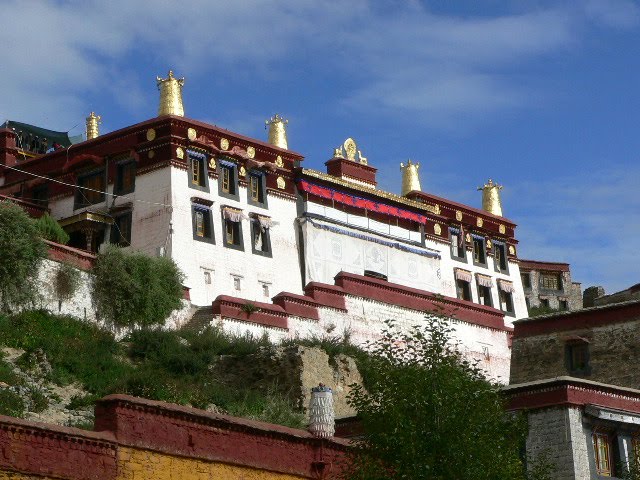
Ganden Monastery is the central monastery for Gelug, the sect in which the present Dalai Lama received his training. It was founded in 1409 by Tsongkhapa.

According to the Wikipedia article on Gelug sect:

“Tsongkhapa was an enthusiastic promoter of the Kadam School’s emphasis on the Mahayana principles of universal compassion as the fundamental spiritual orientation. He combined this with a strong emphasis on the cultivation of in-depth insight into the doctrine of emptiness as propounded by the Indian masters Nagarjuna (2nd century) and Candrakirti (7th century). Tsongkhapa said that these two aspects of the spiritual path, compassion and insight into wisdom, must be rooted in a wholehearted wish for liberation, all impelled by a genuine sense of renunciation. He called these the ‘Three Principal Aspects of the Path'”

Much of the monastery was destroyed by artillery fire in 1959 and 1966. Today it is once again undergoing reconstruction.

Photos taken today are at:

www.flickr.com/photos/11790404@N02/sets/72157622116696100/show/

Sent via BlackBerry by AT&T